Home | For sale | Site map | Contact information | Guest book | Patronentrommel 34
| Adjusting
the
PT34


|
Home | For sale | Site map | Contact information | Guest book | Patronentrommel 34
| Adjusting
the
PT34 |
|
|
|
Welcome to a detailed walk through the details and specifications of the famous Patronentrommel 34 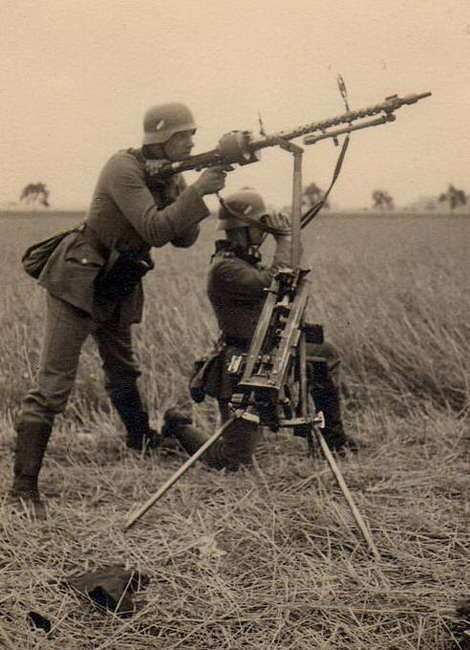 The photo above is one of the very few original photos I have managed to find that shows the Patronentrommel 34 in use. It appears that the gun has been put into the AA-role, as the AA-sights are in place and the gunner has his eyes on the sky. The observer with the binoculars is watching the horizon though. Might be a early campaign photo from Poland or (most likely) from a pre-war exercise. The double decal helmets and dark collared M36 uniforms supports this theory. The overall view (or what is actually what!) According to the Heeresdienstvorschrift (Field Manual) 127/1 from 1936: "The Cartridge drum ensures the supply of cartridges during shooting at air-targets, and can be used towards ground targets if a state of high readiness during advancement is needed. Capacity is 75 rounds." The MG34 originally came with a very wide range of accessories, but as the war progressed the number of accessories manufactured dwindled. The Patronentrommel 34 (PT34) is special, as it appears that it wasn't just decided to stop the manufacturing of it, but the existing numbers of the PT34 must have been withdrawn from service and then re-circulated (as in destroyed!) during the war. According to the text above the PT34 was obviously meant for the Mg34 in the AA role or as a static gun. 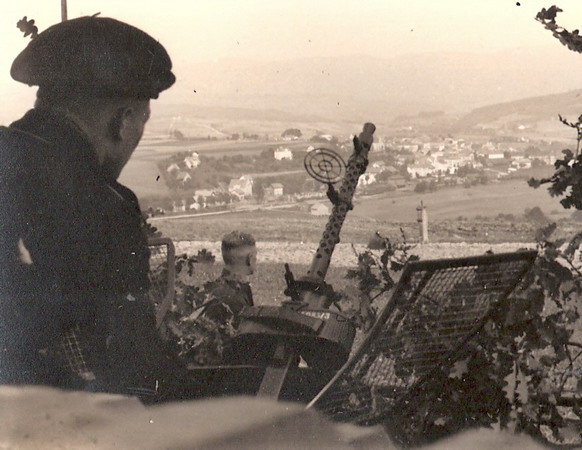 It also saw use on the Zwillingsockel 36, in tanks, on armoured cars (SdKfz 221 above) and halftracks. 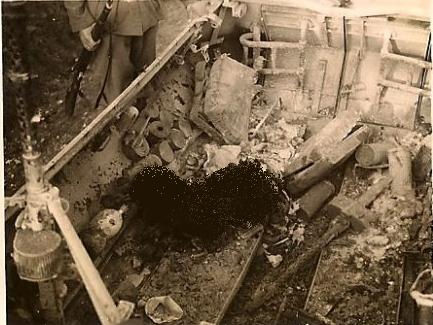 (Picture by courtesy of Carles in Barcelona) The above picture shows a burnt out SdKfz 251 half-track vehicle. Note that both the front and rear (although fallen into the bottom of the vehicle) MG has been set up with the PT34. 5 burnt out Patronentrommel 34's can be seen on the inside wall just in front of the standing soldier. 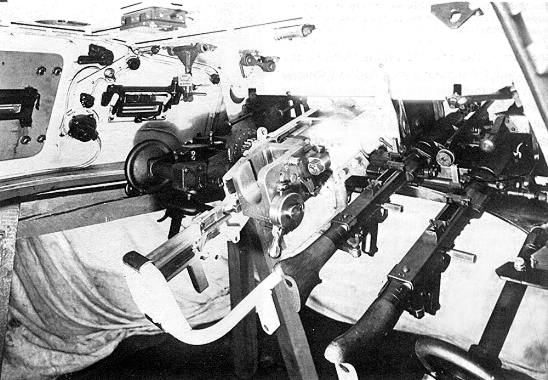 The above picture shows a experimental tank turret set-up (note the turret is on a wooden-stand). The MG34 used are of the standard type, and not the "Panzermantel" normally found in tanks of later production. The Trommelhalters in use are of the "Model 1", with the MG15 release-button-safety! 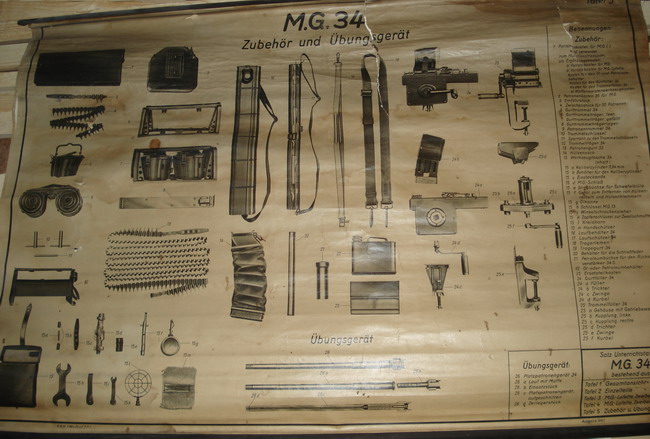 This wall-chart show the different accessories available for the MG34 in 1941 when it was printed. The MG34 could be fed either by a 75 round magazine (PT34) or with a belt (Gurt). The belt was normally a 50 round belt, but could be linked together to any desired length. There was also a manufactured 250 round belt (as visible in the picture above), the Gurt 33. When on the move or when an assistant gunner wasn't practical, the 50 round belt encased in a Gurtrommel 34 was used. The Gurtrommel 34 proved very practical and saw use until the end of the war, also with the Mg42. 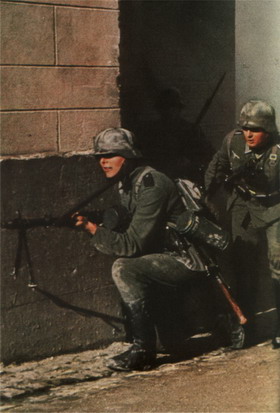 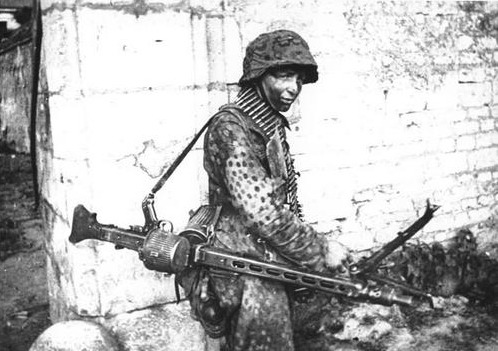 But what is important to understand is that the Gurtrommel 34 is NOT a magazine. It simply holds a curled 50 round belt to stop it from snagging, twisting and getting stuck! The Patronentrommel 34 is indeed a magazine and a rather complicated one as such! It holds 75 loose rounds in two spring-powered spirals twisting in opposite direction, feeding the chamber from opposite sides in turn. Compared to the Gurttrommel the positive effects are of course that the gun will not lean to one side, as the magazine loose its rounds in an even way, and you have 25 more rounds at your disposal. The negative effects are of course the added weight of the complicated mechanism, the complicated mechanism itself that needs to be held "tuned" to obtain the correct spring pressure, and the fact that you can't switch to belted ammo once your heavy magazines runs out of juice! Once the Gurttrommel is empty, the gunner can simply switch to belts carried in boxes or around the neck (as the HJ-gunner above!). When the Patronentrommel is empty, another heavy Trommel is needed, or the cover had to be switched and a feed tray installed. In addition, the reloading of belts can be done by hand, while the Patronentrommel 34 needs tools to be reloaded. Due to this, the PT34 was primarily meant to be used with the Dreibein 34 in the AA role, and only secondary as an assault magazine. The big confusion So, now we know the difference between a Gurttrommel 34 and a Patronentrommel 34. The next problem to sort out is the MG-15 / MG-34 saddle drum trouble! The MG15 was designed as an onboard gun and was used in many of the Luftwaffe's bomber, transport and recognisance planes. The only magazine ever made for the MG15 was the Doppeltrommel 15 (D-T 15). As the war progressed and the number of available LW aircrafts dwindled, the MG15 was put into service on the ground. This was achieved by adding a butt stock and a MG34 bipod mounted on a special jacket bracket, as well as new sights. 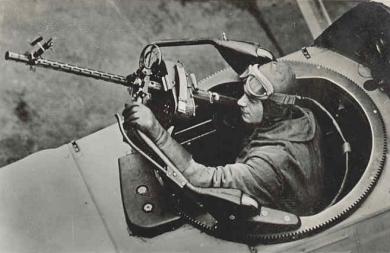 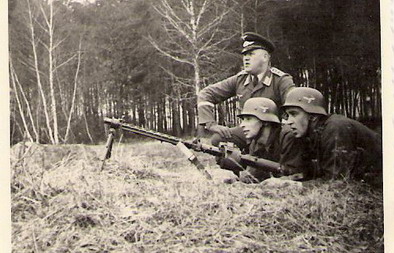 The D-T 15 is now available in big numbers in mint condition, as a large batch of these guns (MG15) with accessories was exported to Bulgaria during the war and then re-exported to the USA post-war as parts kits. The PT34 is obviously based on the D-T 15, but redesigned to fit and function properly on the MG34. A D-T 15 will not fit on a MG34, but a PT34 can be used on a MG15. The PT34 is approximately 250 grams lighter than the D-T 15. Mostly due to a simplified spring mechanism. 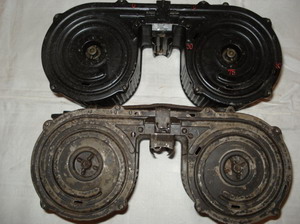 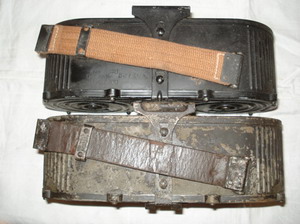 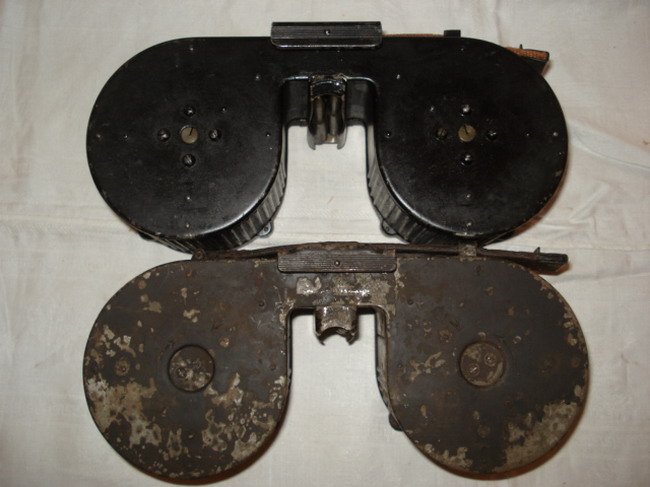 The
above
photos show a D-T 15 (top) compared with a PT34. I must apologize for
the condition of the
PT34. It is a "Wasserfund" (found under water),
but these things don't grow on trees... I know a few other collectors
with mint examples though!
The
re-design (from the D-T 15 to the PT34) was done so that the basic
design of the D-T 15 (of a 75 round saddle drum) could be utilized on
the newly developed
MG34.
First of all, in order to make this happen, the release latch design
had to be changed. The function of this latch is to assist the gunner
in removing the magazine. Used in combination with the strap only
one hand was needed to install and remove the magazine.
The D-T 15 latch has a flat top and a lower edge that has been
bent slightly outwards. The PT34 has a
latch with a straight, narrower front edge and a bulge on top.
Width
is the same. In
addition, the PT34 latch is missing a reinforcement
rib which is on the D-T 15 latch on the rear end.
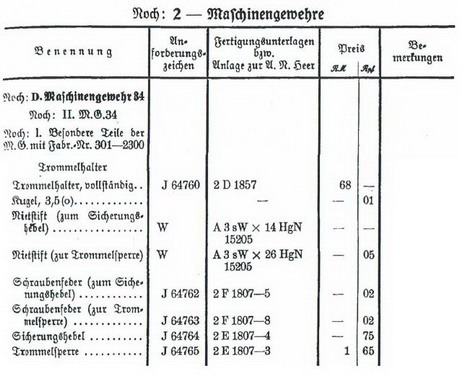
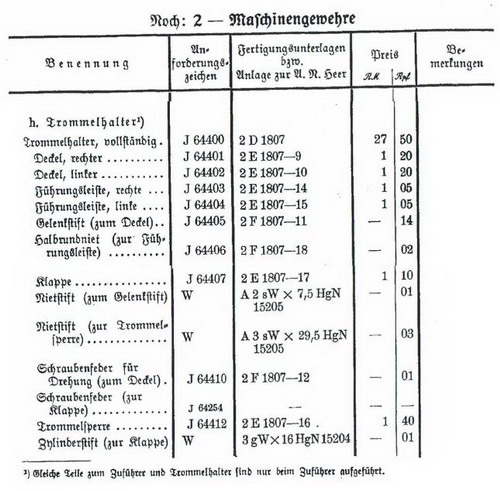
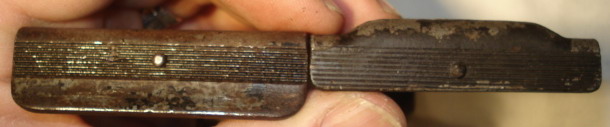 This redesign was crucial, as the D-T 15 handle would not fit on the MG34. (See below!) 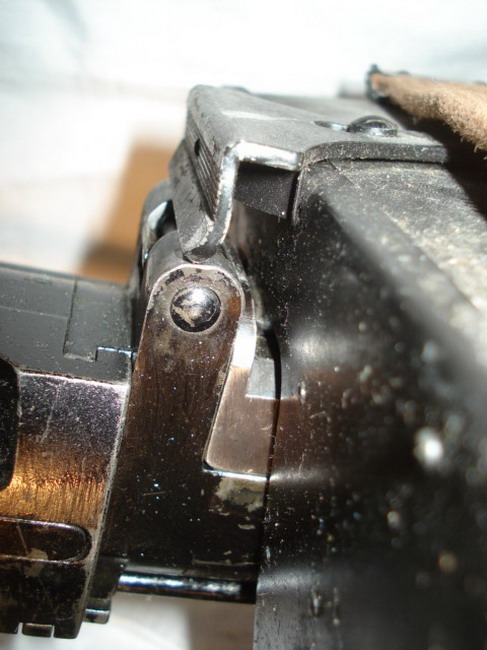 As can be seen on the above photo, the D-T 15 will not go all the way forward as the magazine release latch prevents the full depression of the magazine needed to lock it in the correct position. This can be remedied by removing the latch altogether. This does not give you a fully operational magazine though! Secondly, the spring pressure on the D-T 15 magazines proved too tight for the MG34 bolt spring, so reliable functioning was not achieved. This was remedied by substituting the clockwork spring mechanism with a new and much simplified coiled spring. It is possible to shoot a MG34 with a D-T 15 if the locking latch is removed and the magazine is only half-full. The magazines look identical at first glance, but the easiest way to tell them apart is to study the drum axis. On the front end of the housing the D-T 15 has 4 screws which hold the internal clockwork spring mechanism drum attached. The centre of the axis is in plain view, and a engraved radius line will show any movement of the axis. The PT34 has a circular cover attached with two tiny screws, as well as some markings. For further details about the cover markings, see the drum-adjusting section. 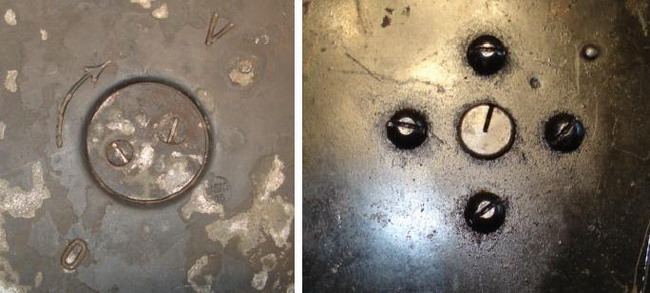 The rear end of the axis also shows differences, although not as easy to spot. On the D-T 15 the housing plate has a reinforcement ring riveted with 4 rivets around the axis hole. On the PT34 the housing plate has no reinforcement at all, the hole around the axis is larger and the spring cover plate inside has 4 depressions easily seen from the rear. 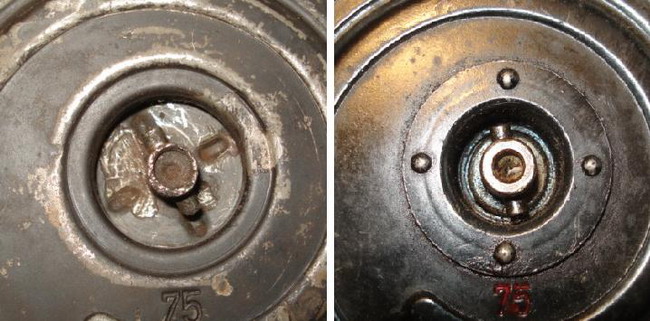 Markings on the Patronentrommel 34 and Doppeltrommel 15 The markings on the two models vary slightly. The PT34 has a maker logo (alternatively a three-letter code), a date (year) and a serial number. The same information can be found on the front cover. The D-T 15 is marked in the same way, but in addition it has the abbreviation "D-T 15" (model designation) and it has also got the Luftwaffe item stock number "Fl. 46300" on the top, which can not be found on the PT34. The D-T 15 lacks the year on the front cover, and only some have the maker logo/code here as well. Markings vary according to date and manufacturer. 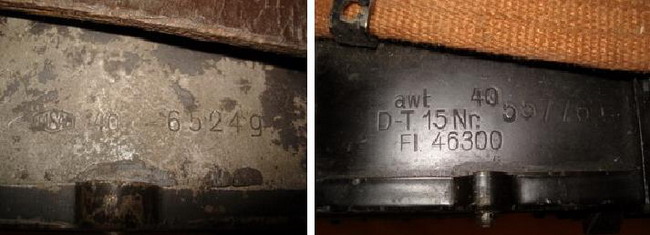 The rear lip of the magazine opening is marked with a army WaA, while the D-T 15 magazines have a LW acceptance mark in the same position. There is also a tiny LW acceptance stamp above the WaA on both PT34 specimens I have studied! In the left photo below it can be seen above the "W" in WaA. This tiny stamp can also be found on early D-T 15 drums, but not the later ones. It is stamped on the rear locking lip, a part which is riveted to the magazine housing. It would be fair to assume that the production of the D-T 15 and the PT34 drew accepted parts from the same pile, although they were LW accepted only! 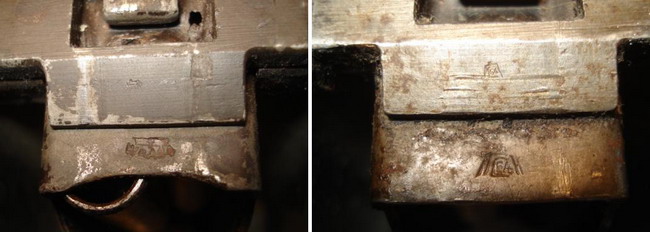 The Patronentrommel 34 has a set of adjusting instructions on the front cover that can't be found on the D-T. 15. See the adjustment section for more details! Both drums have inspection holes for 0-25-50-75 rounds on the right drum with the numbers stamped by the hole and painted red, but only the holes for 0-75 rounds can be found on the left side, and only “0” has been stamped and painted. There are a lot of smaller inspection markings and the likes on all parts of the PT34, but significance is lost! On my specimen all parts have a circle with HASAG and a number within a circle. Well, with the number of exisiting PT34's rising day by day (as fast as they can be fished out of lakes!) I am not going to try to put a "current" value on them. But I have managed to lay my hands on the "J Gerätverszeichnis Infanteriegerät, Teil 2, Maschinengewehre, Berlin 1938" which actually lists the prices of both complete units and parts, and also lists all parts for the PT34! 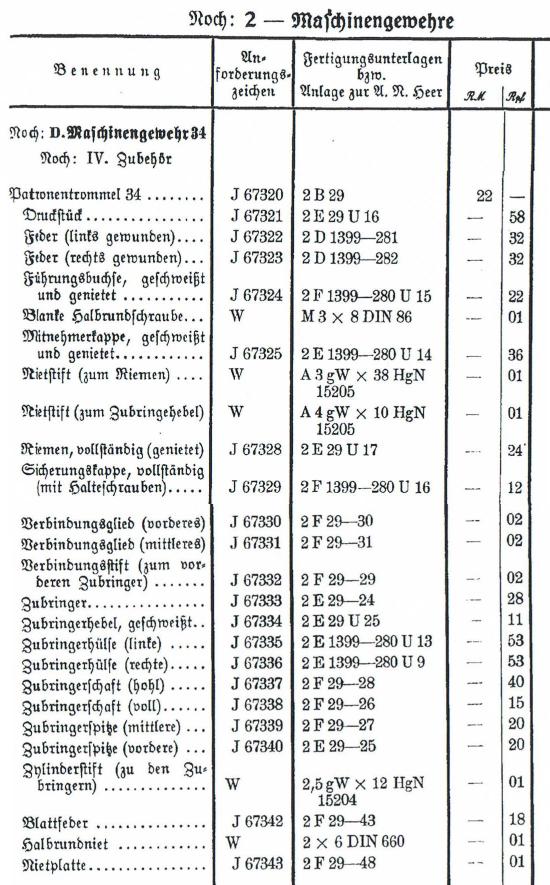 (Above
list supplied by courtesy of Bernd
Birkholz)
Der Trommelhalter The use of the Patronentrommel 34 is of course closely linked with the Trommelhalter. The Trommelhalter substituted the normal cover with the feeding mechanism and the feed tray when in use, thereby switching the gun from belt feeding to magazine use. 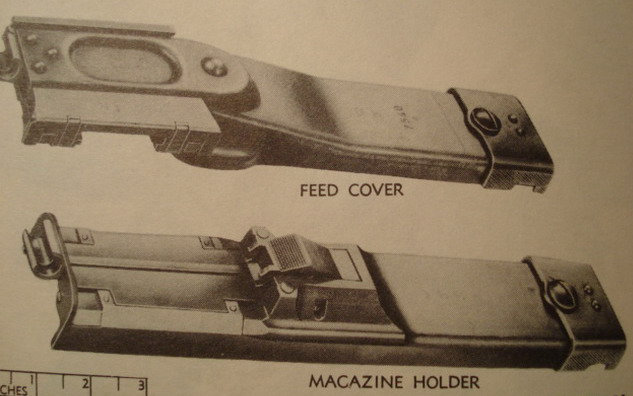 The picture above is from TM E9-206A German 7.9-mm Dual Purpose Machine Gun MG34, 1943. The German designation has been translated to "Magazine holder", which is very correct! The Trommelhalter came in two different models. The "J" list mentioned above states that "MG34's with the factory number of 300 to 2300" was issued with a special Trommelhalter. This should indicate that the guns numbered 1-300 wasn't issued with a Trommelhalter, the guns numbered 301-2300 was issued with the Model 1, and that the guns numbered 2301 and onwards was issued with the "Model 2". This "Model 1" is special as it has no dust doors and a magazine release safety lock copied from the MG15. 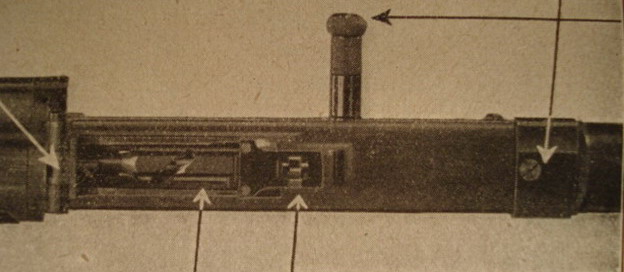 The D.127/1 from 1936 shows a Model 1 Trommelhalter and a prototype cooking handle with a knob. As the locking latch appears to be machined (and not stamped like production units) my guess is that the gun in this illustration is a pre-production prototype. The following pictures shows a standard Trommelhalter (Model 2). 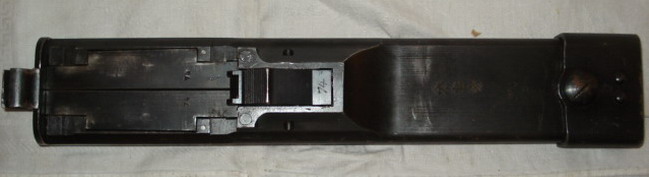 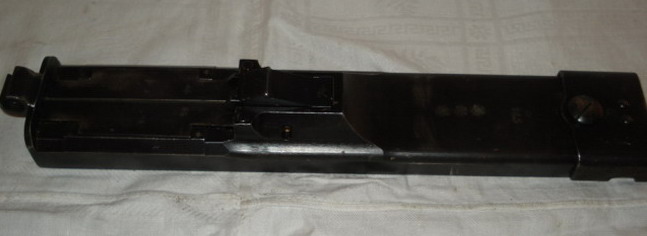 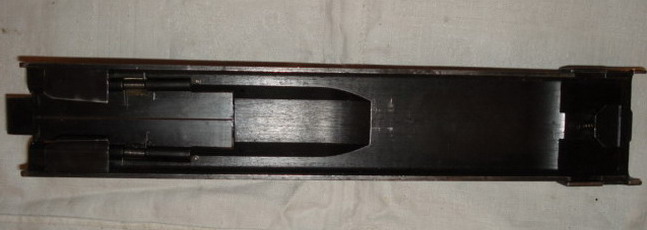 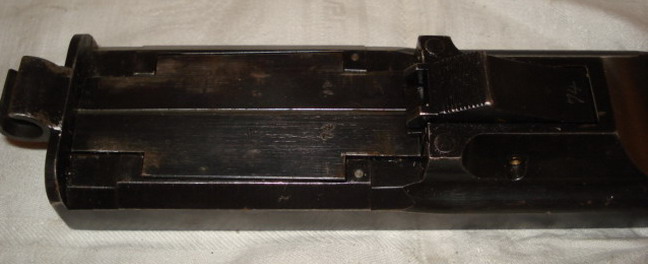 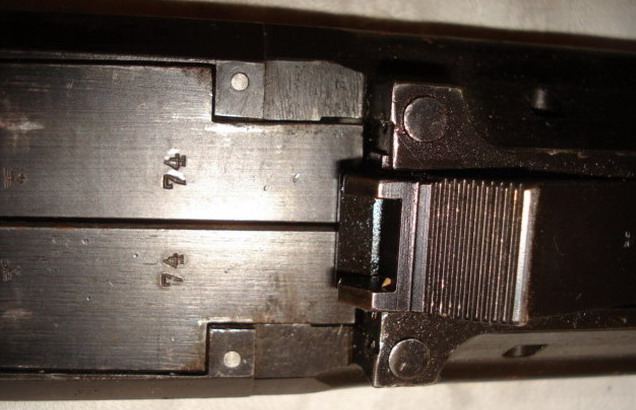 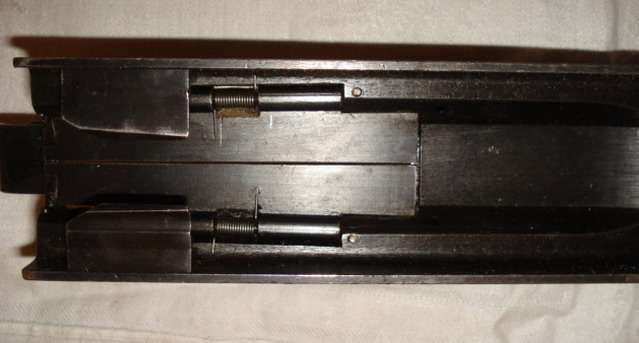 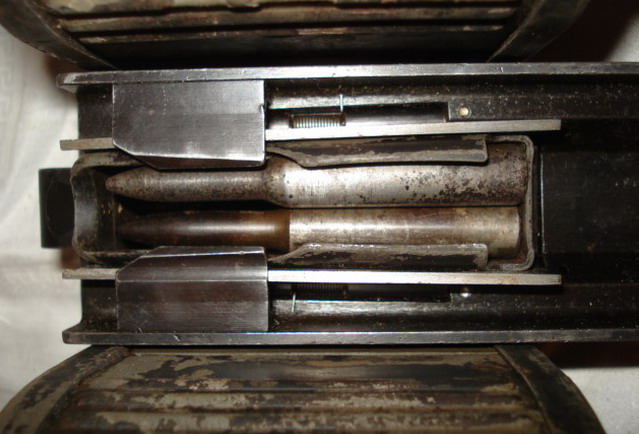 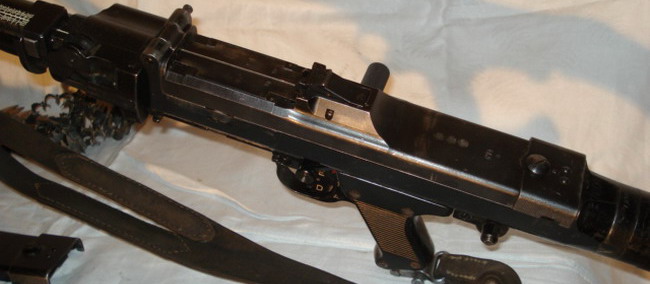 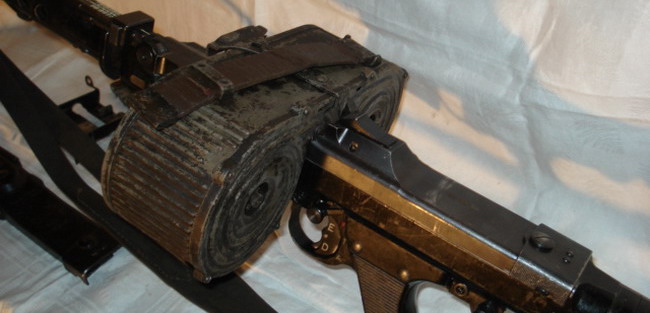 The Trommelhalter normally has a serial number with or without a index letter. It is still unclear if this number is indeed matching the gun it was once issued with. If so, was there a Trommelhalter for every gun manufactured in the early years of production? The Trommelhalter itself has several parts, and according to early German WW2 craftsmanship, the serial number’s last two digits can be found on most small parts of the Trommelhalter. 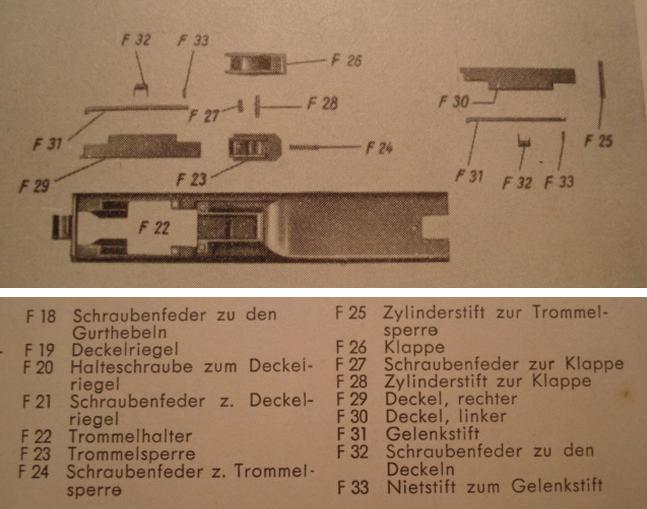 The picture above shows the Trommelhalter broken down in parts. Picture taken from "D124/1 Maschinengewehr 34, Teil 1, Waffe" The aforementioned "J" list also list the parts for both the Model 1 and Model 2 Trommelhalters with prices. Note that exchangable parts with the standard feed cover (Zuführer) was not listed!
The Patronentrommel 34 in use War-time photos of the PT34 in use appear to be very rare. Pictures showing it in use are mostly from pre-war manoeuvres. 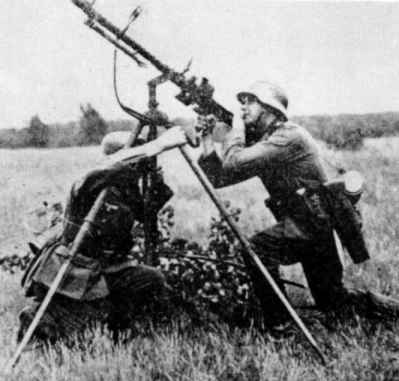 The picture above shows a Mg34 on a Dreibein 34 equipped with a Patronentrommel 34. Note the fallen camouflage and the leather pouch on the gunners left hip. This is the Klapphacke (Collapsible pickaxe) carried according to regulations together with his P.08 and the MG Werkzeugtasche (Gunners tool box). 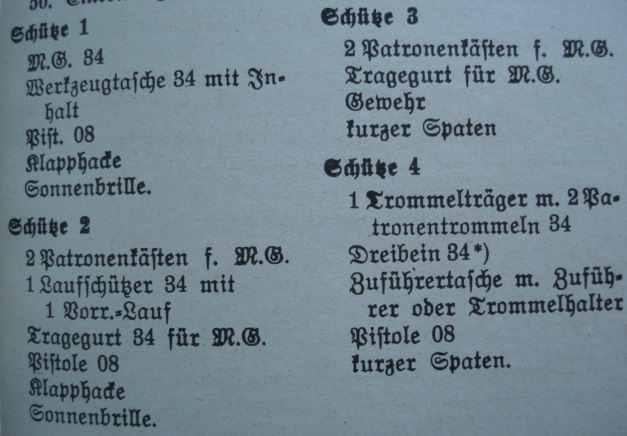 According to the HDV 127/1 Schütze 4 (Gunner #4) was supposed to carry the Dreibein 34, together with the Trommelträger 34 with two Patronentrommels, a entrenching tool, a P.08 and a Zuführertasche m. Zuführer oder Tromelhalter. The Zuführertasche was a brown leather pouch carried on the belt, in the shape of a top cover, but with a slightly wider pouch on the top front containing the cartridge board. I have a set of pictures of a surviving specimen, bot I am not allowed to reproduce the pictures here. Up until now I have had no original pictures of the Zuführertasche, but as always, these things surface sooner or later! Meet Schütze 4! 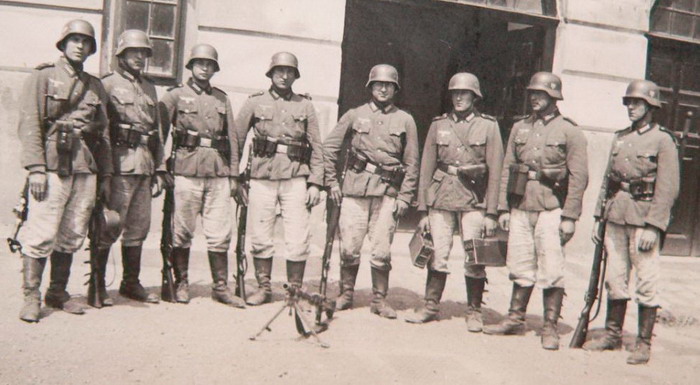
(Picture by courtesy of Gabor in Budapest) This picture is from a pre-war manouver, note the Drillich trousers! Easily identified is the Schütze 4 (Gunner #4) on the far left in the picture. According to the HDV 127/1 he carries the Dreibein 34 slung across his back, a Patronentrommel 34 (he should have had a Trommelträger 34 with 2 PT34!), a P.08 and a Zuführertasche m. Zuführer! An enlargement shows the mysterious Zuführertasche even better! 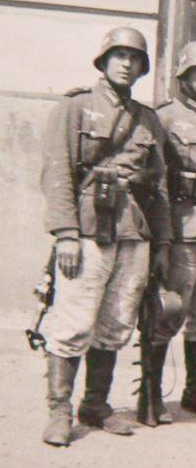 Actual use?! Here
follows a how-to guide for
the lucky owners!
Install the Trommelhalter. Place the left hand under the strap on the magazine, place the magazine in the Trommelhalter, front end down, and press it down until the latch on the Trommelhalter snaps into position. Make sure the strap has returned to it's "flat" position! To remove the PT34, cock the gun and set the safety at "Sicher". Place the left hand under the strap on the magazine, and remove the magazine by pressing the hand against the strap and pushing with the fingers against the latch on top of the magazine. 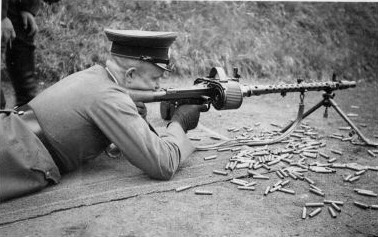
(Picture by courtesy of Ed S)
The picture above shows a NCO at the firing range. Note how the top-strap is interfering with the line-of-sight, as it hasn't been depressed properly after the installation of the magazine. The same problem can be viewed on the first picture on the next page. 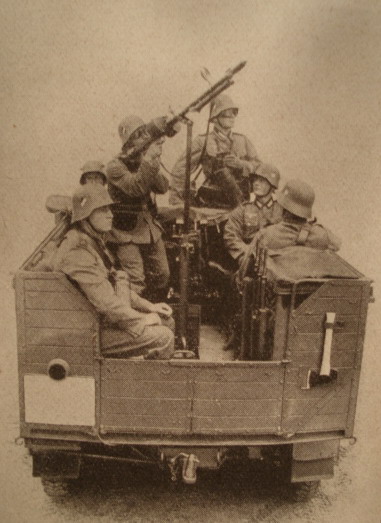 This picture was taken from the D.127/2 and shows the MG34 with a PT34 in the AA-role on a Krupp Protze truck, mounted on the Fliegerdrehstütze 36. Note use of sunglases by the gunner, as described in the MG34 operator's manual! The Patronentrommel 34 in manuals and period publications The PT34 and Trommelhalter were well described in all the early war manuals published by the Wehrmacht on the subject of the MG34. Especially the D.127/1 "Anleitung für die Bedienung und Verwendung des M.G. 34, Teil 1, als l.m.g.", from 11 Oktober 1936 goes heavily into details about the PT34. The D124/1 "Maschinengewehr 34, Beschreibung, Handhabungs- und Behandlungsanleitung, Teil 1, Waffe" from 1. August 1941, also has lots of information about the PT34, the accessories and the Trommelhalter. But, when the same publication is re-released two years later on 1. September 1943, absolutely all mentioning of the PT34, it's accessories and the Trommelhalter has been removed. So it appears that by mid-43 the PT34 was no longer in use at all! On May 25, 1943 the Military intelligence service of the War Department issued a handbook called "German Infantry Weapons" (Special series, no 14). It appears to be based on observers, enemy documents, published propaganda pictures, British publications and wherever possible; actual examination and operation of the weapon concerned. It covers the MG34 in depth, and also covers the use of the "75 round double drum". 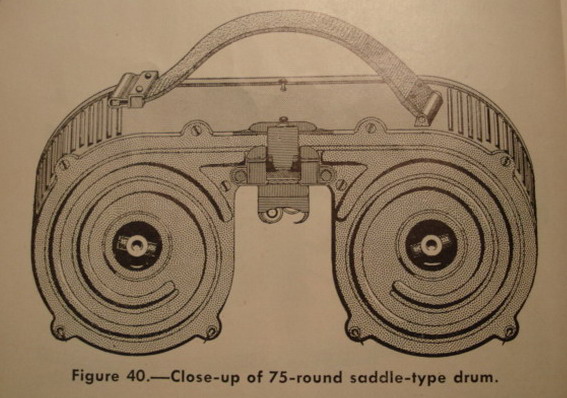 The picture above is taken from the handbook discussed above. What is interesting is the fact that the release latch was missing when the picture was drawn. It is highly likely that the gun examined did not come with a PT34 at all, but a D-T 15! A D-T 15 with the latch installed would not be possible to use on the Trommelhalter. In addition, the drawing shows the typical tensioning ratchets of the D-T 15, and not the PT34 which has a larger centre hole and thinner-walled axis bolt. The same manual also have a interesting note on the MG42: "It is not known whether a special feed cover to take a 75-round saddle-type drum is made for this gun". Keeping in mind that this book was released long before most German units could even dream about receiving any MG42's it's not a bad guess, although the PT34 was probably already history for the Mg34! W.H.B. Smiths “Small arms of the world”, 1948 edition has what I believe to be a Aberdeen Proving ground picture of a MG34 with accessories, showing a saddle drum with the release latch missing, and yes; it is a D-T 15. Most likely the studies for the handbook above were based on this actual captured weapon with accessories! Another publication, obviously not known to the writer of the handbook above was released on 13 April 1943: TM E9-206A German 7.9-mm Dual Purpose Machine Gun MG34. This TM is relatively accurate on the subject, and it is beyond doubt that the writer has had full access to both the PT34 and the Trommelhalter. 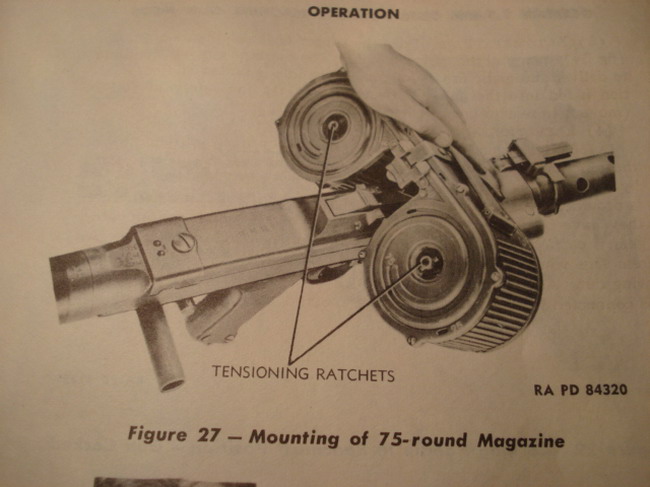 (Note non-correct use of hand strap in the picture above!) Above is a US instructional film on enemy equipment showing set up of the Dreibein 34 and the use of a Trommelhalter 34 with the PT34. (Thanks to Carles in Barcelona for the information). The German publications from 1936 to 1941 are stuffed with pictures of the drum and accessories. 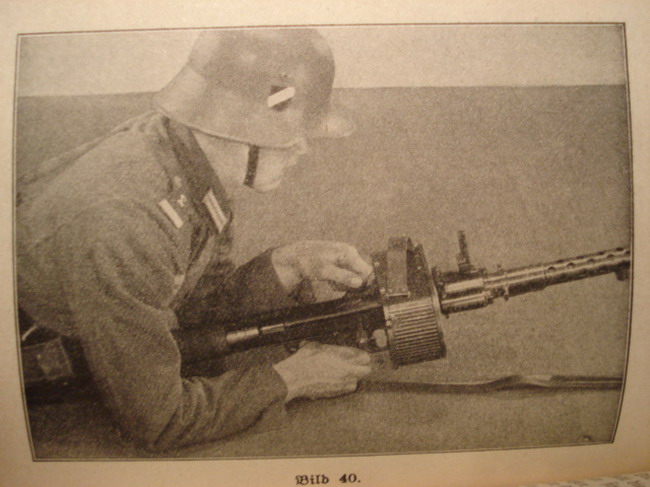 Carrying the Patronentrommel 34 The PT34 is a heavy object, especially when filled with cartridges. The Germans invented a device to ease the transport of the PT34's in the field. The carrying handle mounted on each PT34 is too stiff to aid in this function and is only practical as a hand-support when attaching the PT34 to the Trommeldeckel, or when only carrying 1 single PT34. The answer was the Trommelträger 34. 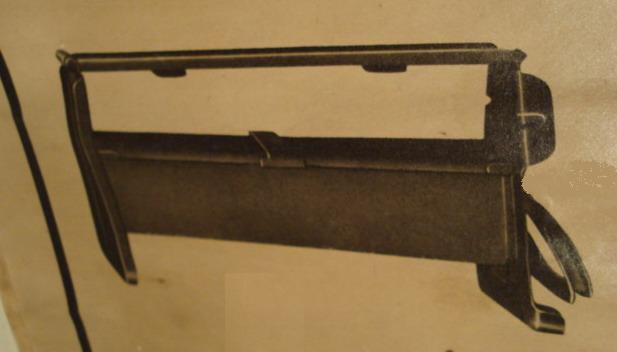 The Trommelträger 34 is so rare that I only know of one existsing example, which belongs to a good friend of mine in the USA. The following pictures are all courtesy of K-man! 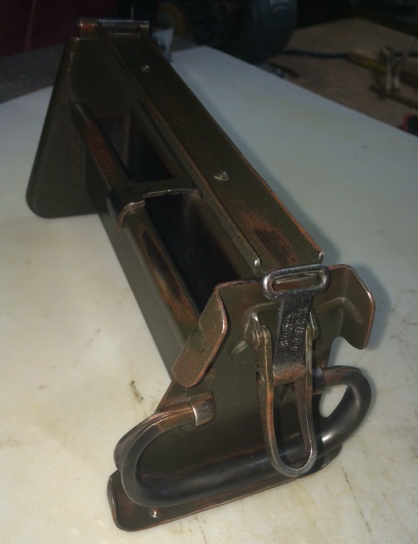 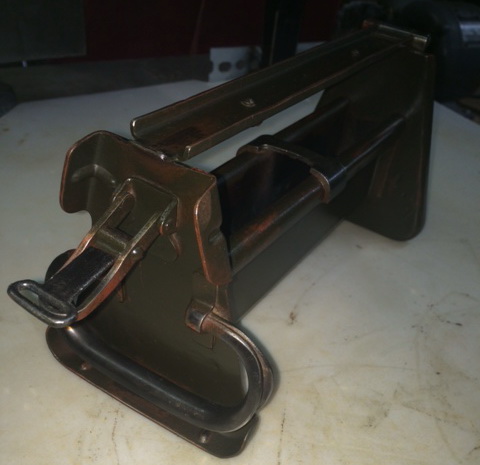 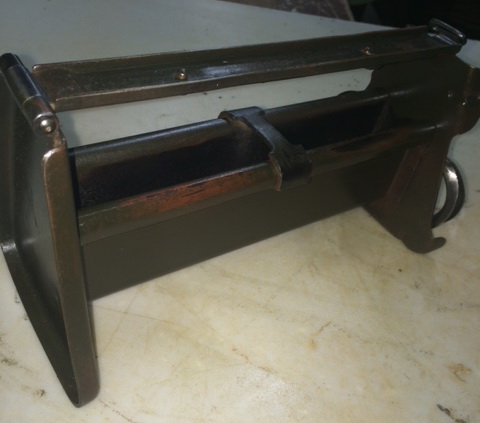 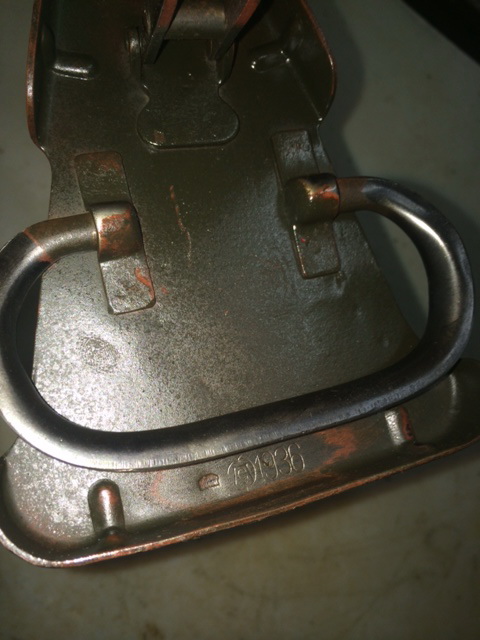 The Patronenträger 34 was constructed to take two PT34, carried across according to the photo below, and would function very much the same way as the Gurtrommelträger, but considerably heavier! 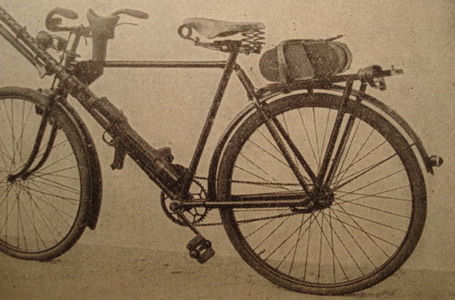 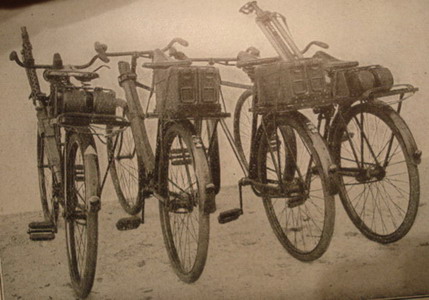 These pictures show the Patronenträger 34 on bicycles, with the Patronentrommel 34 inserted in the carrying frame. Note how the use of the AA Dreibein 34 is linked with the use of the PT34. 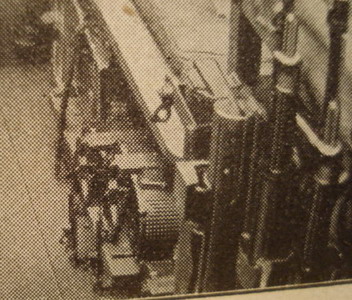 This picture shows the stowage of 2 full Patronenträger 34's onboard a Krupp Protze truck. 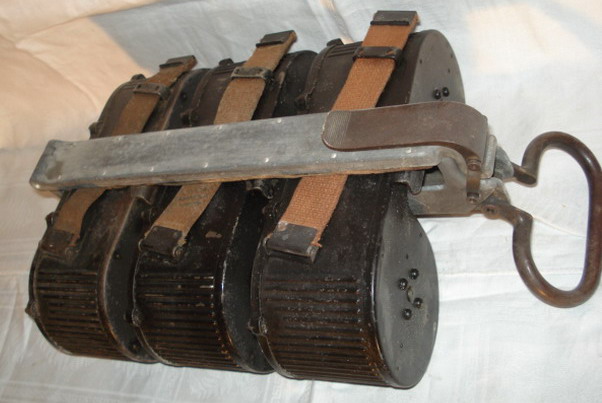 And just to avoid any confusion once again! The D-T 15 also had a carrying frame, but is much simpler than the Trommelträger 34. It has a capacity of 3 D-T 15. Post-war use & copies As the PT34 and the Trommelhalter appears to have been removed from active duty approximately mid 1943 very few examples of the PT34 appears to have survived the war. It appears that no post-war army actually had any numbers of these. But as the collector market grows more and more aware of the scarcity of these, more and more appears to "re-surface". Just a few years back, known examples could only be studied at museums, but lately several fine examples can be found on collector's hands! Some are fished out of lakes and others are ground dug. But late 2008 a very fine specimen was found in a garage sale in the US. So they are out there! I saw my first Trommelhalter back in 1985 in "Regimentals" in London. There was a nice pile of unfinished (in the white) Trommelhalters resting on the shelf, but of course copies! Until the start of this millennium originals remained "Chicken-teeth" rare. Then an unknown number of them (according to rumour) was rediscovered in a old Russian army depot in the former Königsberg area. These covers (or magazine holders!) are all genuine, and are easily identified by the fact that the three large WaA's placed on the top are "X"'ed out, due to their clear swastikas. Apparently, covers not destroyed by the end of the war must have been gathered up and stored away by the Russians. But without the PT34, they saw no further use post-war! Copies of the Trommelhalter have been manufactured steadily over the last decades, but never in a large scale. Sadly, I have no photo of these. The PT34 has not been copied to my knowledge, but almost every second Militaria-dealer selling D-T 15's also claim they will fit the MG34! Modified D-T 15 magazines are now also available in the USA, which will fit and function on the Trommelhalter and the MG34. So, how do you fill and adjust a Patronentrommel 34? Check out my Adjusting the PT34 page! |
|
Home | For sale | Site map | Contact information | Guest book | Patronentrommel 34
| Adjusting
the
PT34 |