

| Home | For sale | Site map | Contact information | Guest book | Lafette-menu |
 The
Lafette The
Lafette |
|---|
Paintwork and finishNow, let's turn on the colors!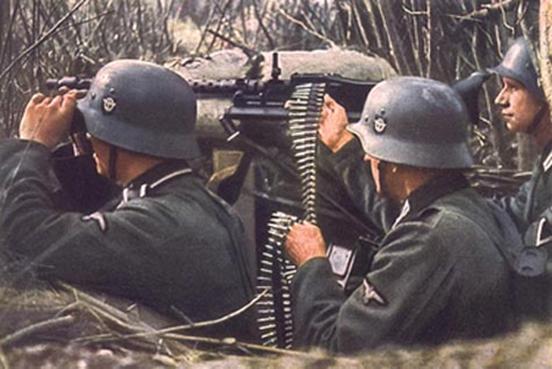 The paintwork of the Lafette is well worth a study of it's own. Normally the paintwork of a Lafette will fall into one of four categories:
To
determine which is which, a close look at the actual painted areas
and what it is that has been painted should be enough! A factory paint
job was applied by spraying the parts and leaving them with a nice and
even surface with a solid, semi-gloss baked appearance. Field paint
would most of the time be applied with a brush, leaving rough brush
strokes. But it could also be applied as spray paint, although this
would be much rougher than the factory finish. A field applied paint
finish would also leave traces of the original factory paintwork
underneath. If the paint doesn't match the typical German equipment
colors of Dunkelgrau or Dunkelgelb it is most likely post-war applied
and falls into the category "Repaint".
If the Lafette has no
trace of the factory applied original paint it has been post-war "Refurbished";
stripped of all paint and repainted entirely.
And out of these, the first one is of course the one that is most interesting! Factory paint 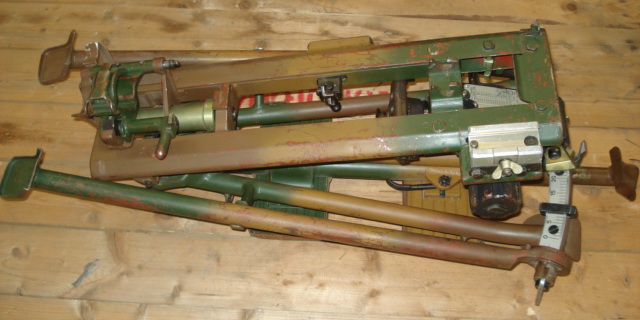 A 1938 dated
Lafette in factory applied 3-tone camouflage.
The painting of the Lafette must have been a pretty standardized job. Each Lafette was painted by the manufacturer according to the "color of the year". It appears that central orders have been issued in regards to which color scheme the procuring authorities wanted their items delivered in. By studying different types of items I have found a pattern that seems to be very consistent in regards to colors. Roughly, the Wehrmacht started up with a 3-colour camouflage of tan/green/brown, then switched to Dunkelgrau (panzergray) with brown camouflage, then reduced the demand to only Dunkelgrau, and then finally switched to just Dunkelgelb (tan).
The
earliest year of manufacture I have been able to study was 1936,
the first year of serial production. It was field repainted, but had a
clear 3-tone camouflage under the Dunkelgrau.
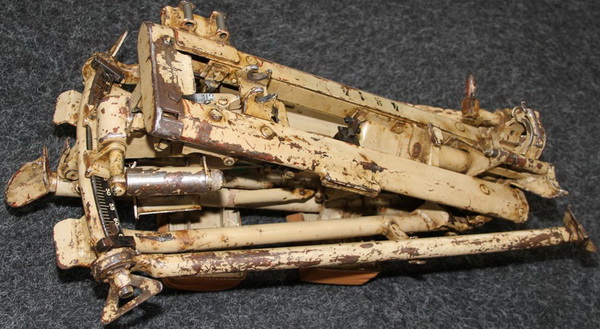 The latest manufactured Lafette 34 I have seen was a 1943 ecy (above) and it was painted Dunkelgelb. Only one specimen has been observed, and details about it suggests it must have been at the end of the line for the MG34 Lafette production. The tan (Dunkelgelb) paint was only introduced in the industry somewhere into 1943, and by then the production of the Lafette 34 seems to have been coming to an end, leaving production capacities for the Lafette 42. MG42 Lafettes were first manufactured in Dunkelgrau in 1943. They then switched to Dunkelgelb the same year. At the fsu factory the change took place between serial number 4033a and 4884a. The only 1944 dated Lafette 34's I have seen are from the Portuguese contract, and they carry their very own green color. 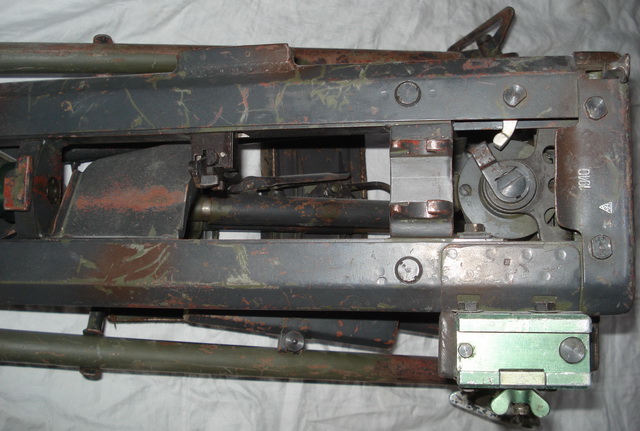 A
1940 dated Lafette. Note the Dunkelgrau paintwork with factory applied
brown camouflage. The OD paint traces are all postwar Norwegian.
The paint scheme follows the year of production for the pre 1943 production, but some items change color during the year as well. An example not adhering to the "color of the year"standards is the sub-manufactured search-fire mechanism on the 1938 3-tone camouflage Lafettes (study the picture on top of the page!). On more than one of these the search-fire mechanism was factory painted in Dunkelgrau with brown camouflage (as 1939 standard). One specimen studied had actually been repainted by the troops to the 3-tone camouflage! But I think we can safely say that the color scheme never "travelled backwards". Application of paint at the factory must have been done at certain stages of production. Some of the hardware was mounted, and some not, as some of the blued screws and bolts show no sign of painting at all, while others were clearly mounted at the time of spraying (and never blued at all!). By observing the 1938 Lafette 34 in camouflage I would say that the main parts were sprayed before they were assembled. And again, some of the minor sub-assemblies had not yet been attached at the time of painting. Items not painted on the early production included: -The pivot for the AA-extension. It was masked off and left unpainted, as the surrounding area was painted. -The hidden extension of the front leg. -The hidden extension of the front leg support arm. -The T&E mechanism. This was clearly painted by the sub-supplier and delivered ready for mounting. -Almost all aluminum hardware, like the buffer spring assembly and the supporting brackets of the rear locking lip. Excluded are the large wing nuts of the rear legs, which was indeed painted. -Some blued details, like the trigger actuator block with selective fire mechanism and the levers for the leg extension lock and front leg support extension lock. -The optical sight block in aluminum with its blued iron support. -The aluminum or steel T&A arch with mounting hardware. 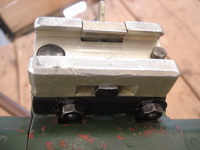 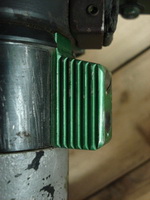 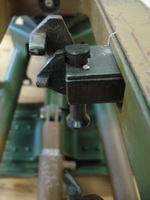 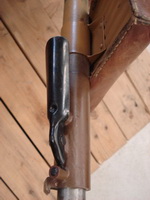 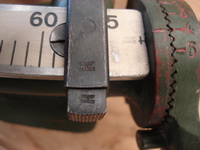 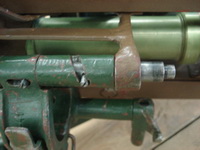 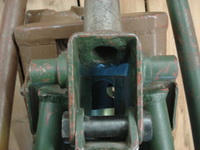 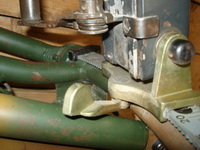 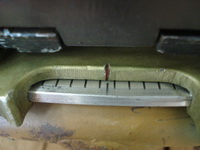 Pictures
above show hardware or areas that was left unpainted on a 1938 Lafette
Also worth mentioning; the adjustable front pad was mounted on the leg after painting, so that the front leg would have a painted surface any which way the pad was placed. The leather pads were then sewn on and the leg assembled. Late war made Lafettes have turned up where the search-fire mechanism is left unpainted. It appears to be blued or phospathed, most probably to save manufacturing time. These have been observed on both dar and fsu Lafettes (the later manufacturer using cql made search-fire mechanisms). Field paint Any item used for some time would eventually need a repaint; most often applied by the troops in the field themselves. Camouflage also saw renewed interest towards the end of the war, and with the items already delivered in tan; troops just added green and brown and got what helmet collectors today refer to as the "Normandy" camouflage. But as we can see, that was only the "wheel of paint" doing a full turn as we were back in 1936 again! Another version of the camouflage would of course have been the whitewash for winter warfare. I have never seen any surviving original Lafettes in whitewash, but since the war ended in May that isn't strange at all, as it would have been removed as the snow melted. (But hey, what a tempting idea for the fakers :-) 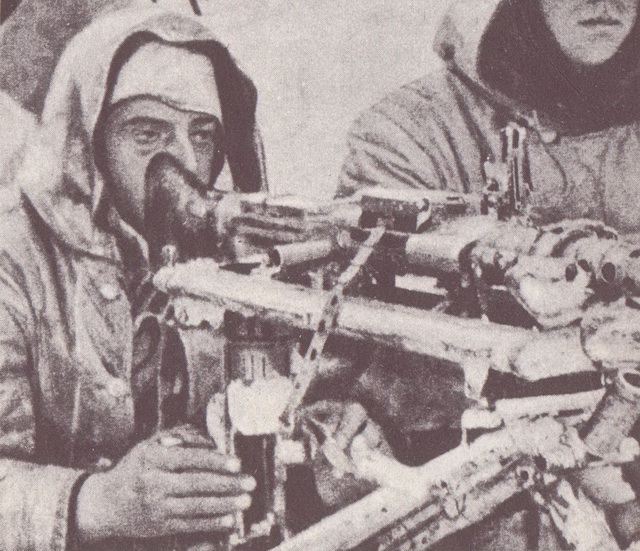 Picture
published in Der Adler. This is a whitewashed Lafette 34, but it has
also got a fair amount of snow on it. Note the eyes of the gunner.
Field applied paint jobs consisted either of repainting the item in question with the same color, changing the color to the "color of the year" or adding camouflage. In theory, the color could also be changed "back" to earlier patterns. I do have a factory painted Laufschützer in tan that has been repainted in the field to Dunkelgrau, most probably because it suited the troops better...So in theory, the same could have happened to a Lafette! 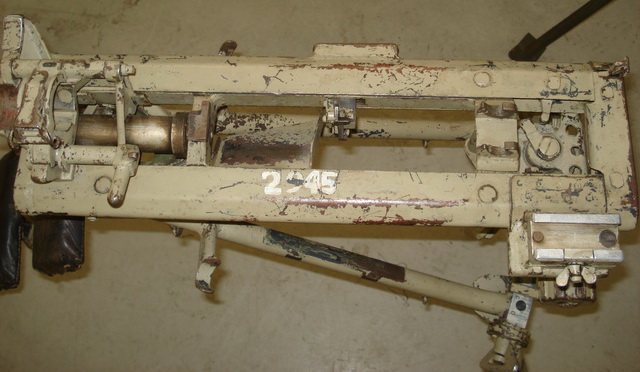 Another 1940 dated Lafette. It was factory painted in Dunkelgrau, but later got a coating of Dunkelgelb in the field. Note the removed bolt box. 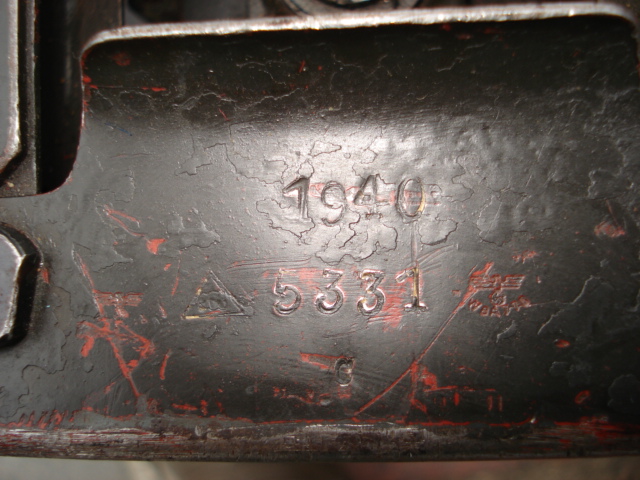 And yet
another 1940 dated Lafette. This one has been field painted in
Dunkelgrau above the factory applied Dunkelgrau.
As mentioned earlier, the field repaint was mostly carried out by using brush. The field painted Lafettes tended to receive more paint than the factory finish gave them. The troops repainted the aluminum parts, which tended to lose their anodized finish, like the sight block, the buffer spring assembly etc. The work carried out would of course be sloppier than the factory finish. 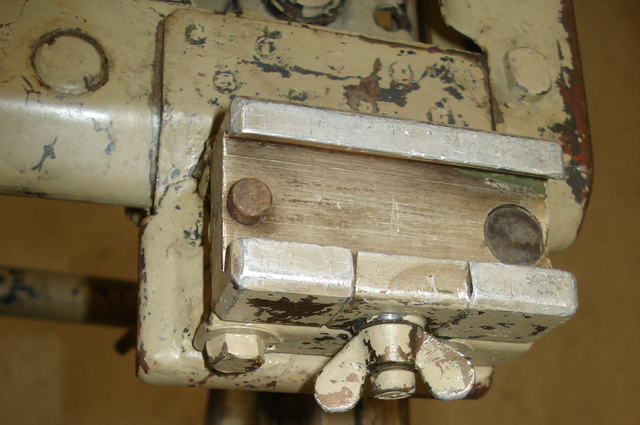 Note how the
Dunkelgelb paint has been liberally applied to the optic block, base
and hardware.
Repaint A repainted Lafette is a post-war painted original. The very nature of the repainted Lafette means that it has gone from WW2 service in German colors to do service for another nation post-war in a new coat of paint. The good thing about a repaint is that the original paintwork is underneath the repaint, and that the repaint in most cases has preserved the original paintwork from post-war wear and tear. In some cases it is well worth restoring it back to the original color. But this depends on how much of the original paint that was left prior to the repaint and how easy it is to remove the repaint! Typical repaints are the Lafette 34 used post-war by the Norwegian army. These Lafettes were airbrushed, leaving only (most of) the leather pads and the Überschießtafel unpainted. The typical color of a repainted Lafette is Nato Olive Drab. The German WW2 forces never used green painted Lafettes, but more on this subject will be found on the "Postwar era" chapter. 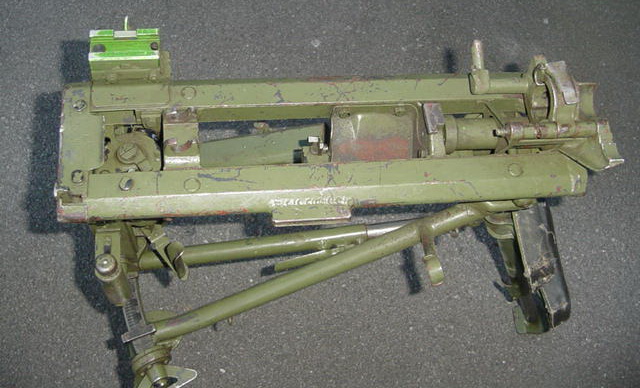 A typical
repaint. Note how the Dunkelgrau and red primer peeks through the
postwar OD in the scratches and worn areas.
Refurbished The refurbished Lafette has normally been stripped for all its original paint and repainted in the color of the new army using it. The paint stripping could have been done chemically with acids/paint strippers or mechanically by sandblasting. The T&E was normally removed prior to this, as it is a delicate instrument and sandblasting the Überschießtafel would mean that it was destroyed (made out of aluminum or celluloid plastic). On many refurbished Lafettes the T&E will be repainted (often black) while the rest of the Lafette has been sandblasted and repainted. Often this was done at the same time as the Lafette 34 was rebuilt to accept the MG3/MG53, but more on this subject will be found on the "Postwar use" chapter. The refurbished Lafettes were normally painted in a green paint, which could range from a pale OD (Austria) to slimy, gooey green in Yugoslavia. If the paint was removed by sandblasting the original German paint can be found underneath the bolt box or behind the clamp holding the lower back pad, and some of the parts will show pitting from removed rust. 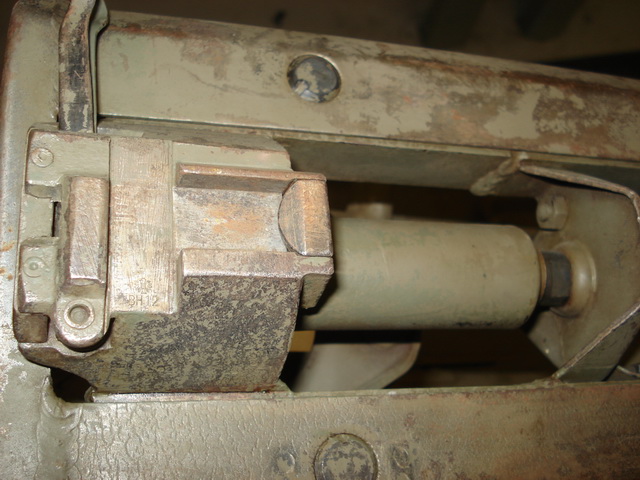 A postwar
refurbished
Lafette 42 from the Bundes Heer (Austrian army). It has been
completely stripped of paint by sandblasting, and repainted without any
primer.
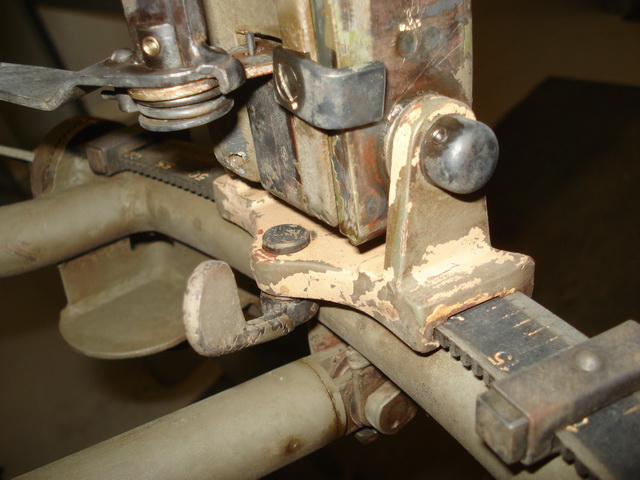 The T&E from the same furbished Lafette. Note how some of the original paintwork is preserved only on the parts of the T&E.. 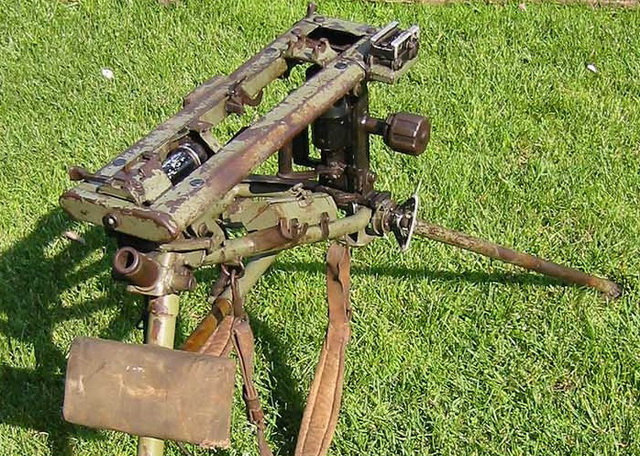 A
Yugoslavian refurbished Lafette for the M53 Machine gun. These are
often hard to tell apart
from the German WW2 Lafettes, as they are mixed up original parts with
new made parts. This specimen is a Lafette 34 with new back pads, new
front weapon mount, new trigger and new bolt box..
Another category of refurbished Lafettes are the ones refurbished by collectors today, to bring them back to their old glory. Most of these are easy enough to tell apart from the real deal with some logical sense. The paint and weathering technique will seldom manage to cover 70 years of age and use that the ones in original color have. Wear and tear to the paint Some of the Lafette's saw heavy wear and had to be repainted during the war years, while others appears next to mint today. 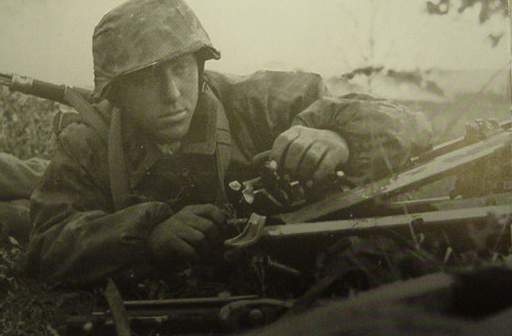 Note
that the legs are worn down to bare metal, and that the cartridge belt
has gnawed off most of the paint to the upper frames left side.
The typical wear pattern to the original factory paint includes the following areas: -The rear legs. This part of the Lafette is by far the most worn part on any Lafette -The spent cartridge tray. It is the part that will get the most of the "mechanical beating" while the Lafette is in use. -The left edge of the upper sleigh, where the cartridge belt gnaws away at the paint if the Schütze #2 doesn't follow up properly and lift the belt! -The firing grip. -All other areas with an edge prone to come in contact with objects while the Lafette is being moved around! 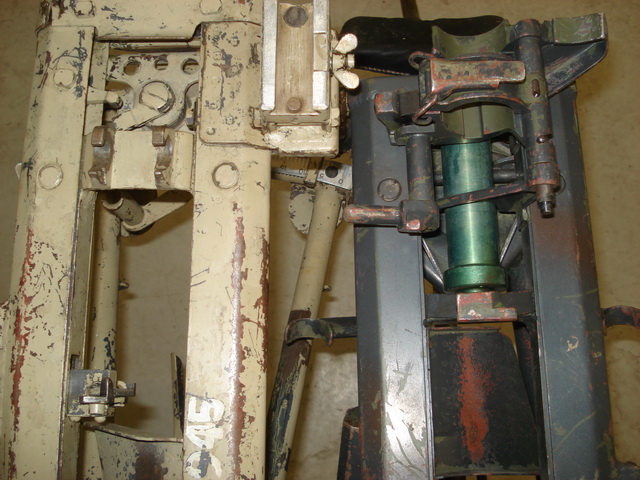 On
the above picture the wear pattern from the spent shells can be
seen clearly. This
picture also show a factory paint (right), a field paint (left), and
partly
in the upper right area a repaint!
Fake paintwork Sad to say, but they work in this field as well. Totally restoring/repainting/marking Yugoslavian "Lafette 53" has now become industry! Take a look at these pictures and try to spot what is wrong with the paintwork. 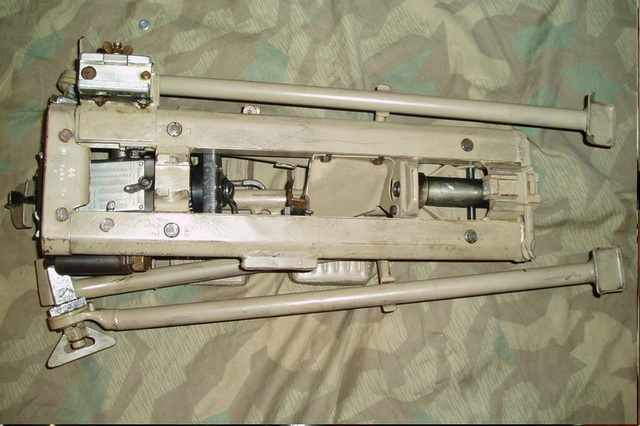 Looks convincing from a distance? The color is a bit "off" and it is too glossy. 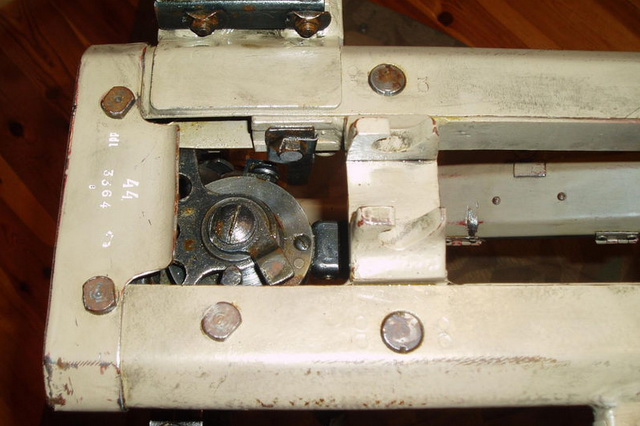 Looking
closer you
will now see the stripes from the sanding paper on the edges. Also note
that the wear and tear to the metal doesn't correspond with the
paintwear at all.
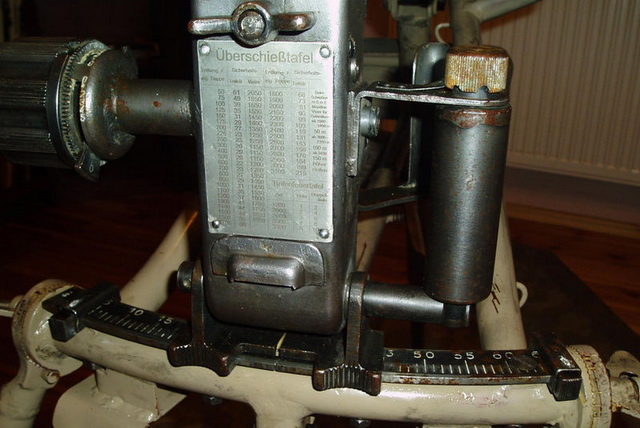 Oouch.
He forgot to study the manual! Even though the Yugos always blued their
search-fire, the Germans almost never did! This practice was only
carried out in the last few months of the war in 1945. Also note the
bad
quality Überschiesstafel! The "tan" metal looks very uneven and almost
handmade.
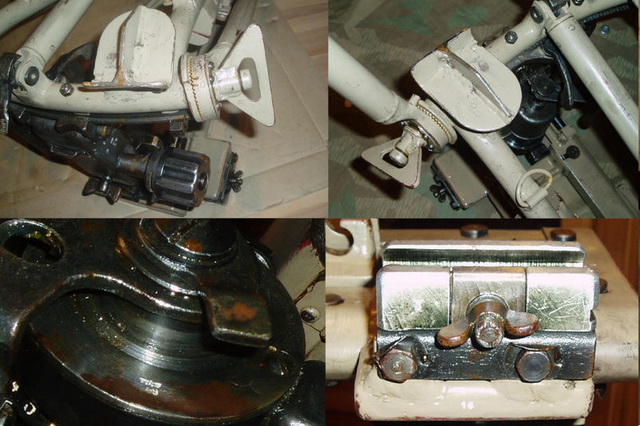 The
Yugo optic block is aluminium that has been anodized deep black. To
disguise this the parts have been sanded down to the bare metal,
leaving only a greyish-black shine. Note the hand made finnish to the
"tan " part that holds the block.
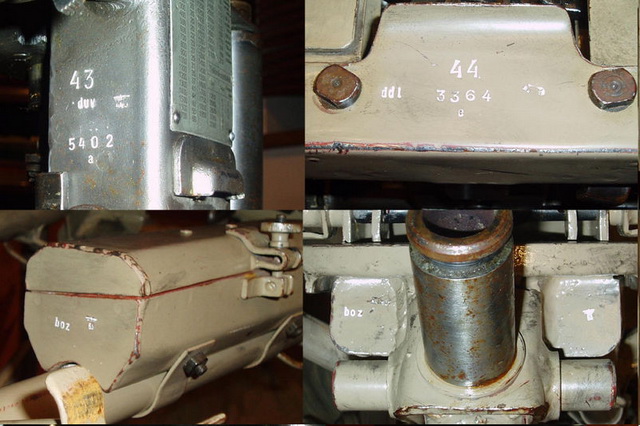 Note the
sanded edges and welding seams, manipulated to look worn (but just
silly in my eyes!)
Now, let us sling our Lafette and move on to another aspect of this fascinating piece of military history! 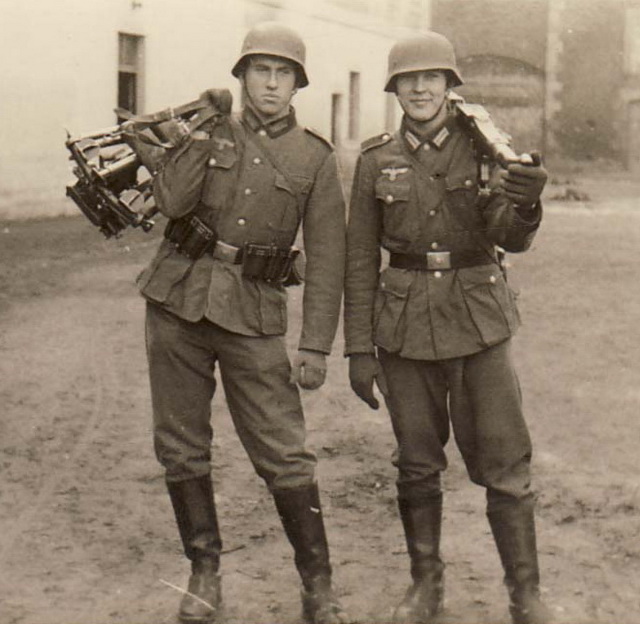 |
| Home | For sale | Site map | Contact information | Guest book | Lafette-menu |