

| Home | For sale | Site map | Contact information | Guest book | Mauser slings page 1 | Mauser slings page 2 | Mounting instructions |
 Mauser
K98k slings Mauser
K98k slings
|
|---|
|
Welcome
to a walk through the details and specifications of the leather sling for the German WW2 Mauser K98k. The overall view 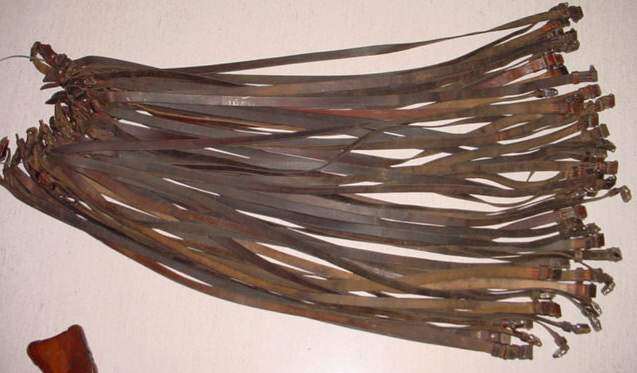 The original sling for the Mauser Karabiner 98 kurz (better known as K98k) has become a much sought after item, and the not-so-original slings flourish today. The sling consisted of the actual sling, with a sewn on buckle and three teardrop shaped holes at the end. In addition a sling loop and a rear sling keeper was needed to complete the sling assembly. The very same sling was also utilized for several new rifles introduced during the war. The G41(W), the G41(M), The G43/K43, The MP43/1/ MP43/MP44/MP45/StG44 and the StG45 all used the J 216 Karabinerriemen. In addition it was also used on most of the "Beutewaffen" that the Germans manufactured in occupied countries. Rifles like the G33/40, the G29 and the G98/40 to mention a few. Some of these were slightly modified to accept the K98k sling. The Karabinerriemen was manufactured by more than 40 different manufacturers from all over Germany, Austria, the former Czechoslovakia and probably several more countries. These manufacturers were all commercial companies, normally manufacturing suitcases and bags, sport merchandise and shoes. The Karabinerriemen was made on orders/contracts with the procurement sections of the Wehrmacht and probably also as subcontractors to the actual K98k manufacturers that needed slings to put on their finished products. Due to this system some sling manufacturers manufactured slings only once, while others could be delivering slings over several years. This also caused some slings to be slightly different from the others, as the manufacturer didn't always strictly adhere to the standards laid out in the contracts. These differences can make it easier to identify who made the sling. At the dawn of time.... In
order to better understand the construction of the Mauser K98k sling I
will have to give you the history that eventually led up to the
final product. The history of "modern" German service rifles started
with the Gewehr 88. This rifle
utilized a swivel buckle that was buttoned on with a double headed
button, and a standard friction buckle for adjustment that was sewn
on. The leather was smooth.
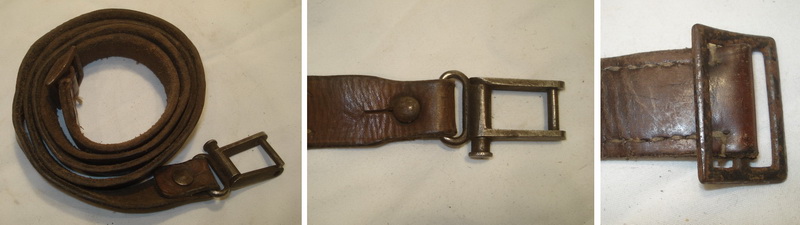 The Gewehr 88 (G88) sling Not very satisfying, the G88 was soon replaced with a new rifle patent, the Gewehr 98. The G98 sling retained the same rear buckle, but it was now sewn on. The friction buckle was redesigned with a button to the rear, and a wire loop was added that could be slipped over a small hook at the nose band to shorten the sling. The end had an eyelet that was buttoned to the rear of the friction buckle. The leather was smooth during the early production, but it was later manufactured in the famous ricasso pattern. 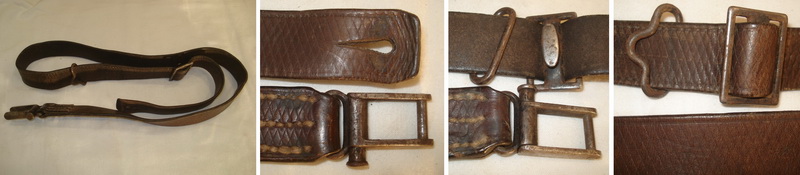 The Gewehr 98 (G98) sling The G98 rifle was also issued in a shorter version, the Karabiner 98AZ. This model was later renamed as the Karabiner 98a in 1923. The stock for the Karabiner had a fine slot through the woodwork enabling the sling to pass through to the other side. The Karabiner 98a sling was called the "Einheitskarabinerriemen" and it used the same friction buckle as the G88 sling. At the rear end the sling had 9 teardrop-shaped holes and a new invention, a leather covered plate with a brass button on, called the "Haltestück". This will be further discussed later. The leather was initially smooth, but changed to the ricasso pattern. 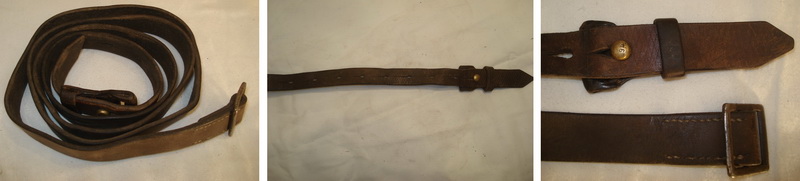 The Karabiner 98a (K98a) sling The same sling was later used on the Karabiner 98b that was manufactured from 1923. It was issued in two lengths, but from 1923 the long length was set as standard (1.36 m). It was not until the year 1935 that the new Mauser sling saw the light of day..... History of the "Karabinerriemen" The introduction of the "Karabinerriemen" was announced on 02 July, 1935 in the "Heeres Verordnungsblatt", published by the Reichskriegsministerium (War Department). It replaced the "Einheitskarabinerriemen" which was ordered discontinued and remaining stocks used on the Karabiner 98b and 98a. This would indicate that the Karabiner 98k was first issued with the "Einheitskarabinerriemen". The new sling was assigned the resupply part number "J 216". 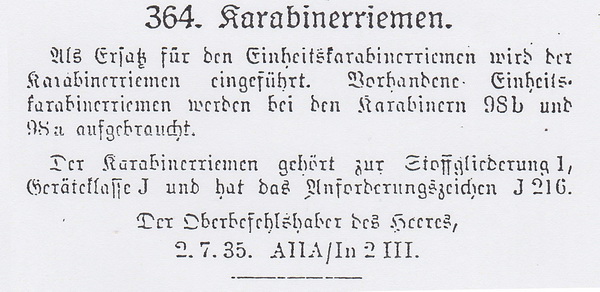 A picture of the actual announcement of the "new sling". 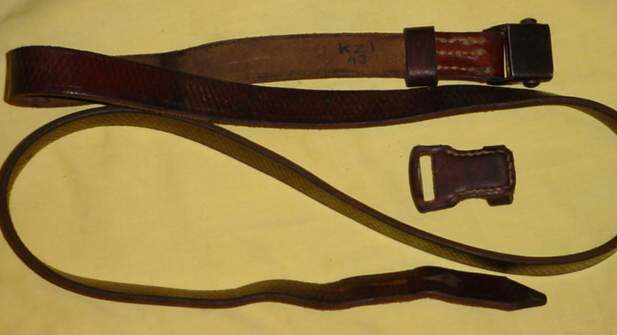 Now let us look at the different parts of the Karabinerriemen. The Buckle (Klemmstück) The buckles were standardized, and made by sub-contractors. The four known variants are L&F, D&C, SC and the ones devoid of markings. 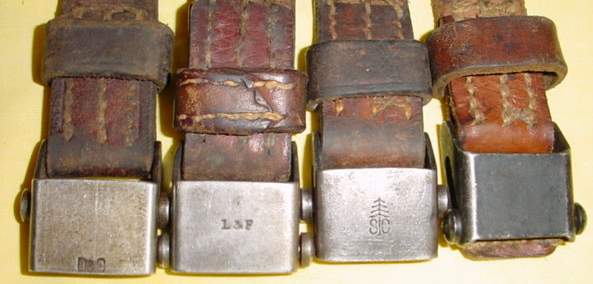 The makers have been identified as follows:
These factory markings only denote the buckle-maker, not the sling maker. Sometimes these buckles can be found on post-war made slings, re-used or from un-used stocks of buckles. The back of the buckle had a leather protector that was supposed to protect the rifle finish. This one was often torn off or worn down due to use. I have observed them on 1944 made slings, but they might have stayed in production until the end. 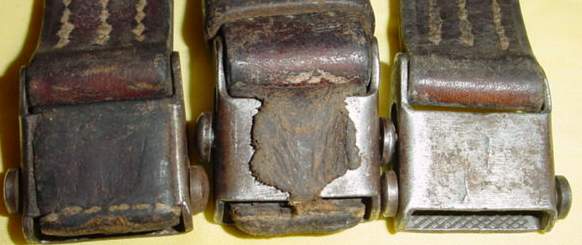 The buckle pin (Klemmwaltze) heads should be flush with the buckle walls on most buckles, but 1944 production buckles have welded ends and a small gap can be present on those. On specimens where the buckle walls have been dented, it might protrude a little bit. 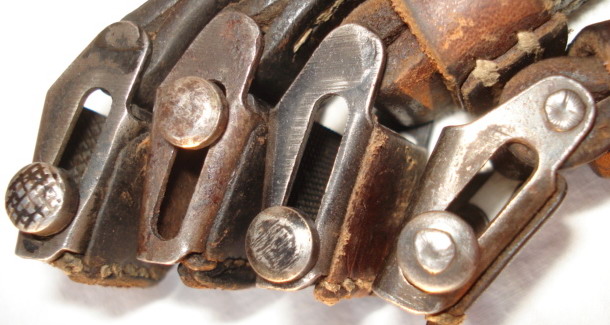 The above slings are from left to right Otto Koberstein 1937, Otto Koberstein 1938, ftt 1942 and cgu 4 The heads of the buckle pin (the one that slides back to release the leather sling) will have many different forms. Just check the photos above and below. The head can be rounded, almost flat, whit a nipple and so on. In short, the roller pin head is no way to safely ID a sling. Some of the very early slings have a serrated pattern on the top of the roller pin heads to give the user a more secure grip. 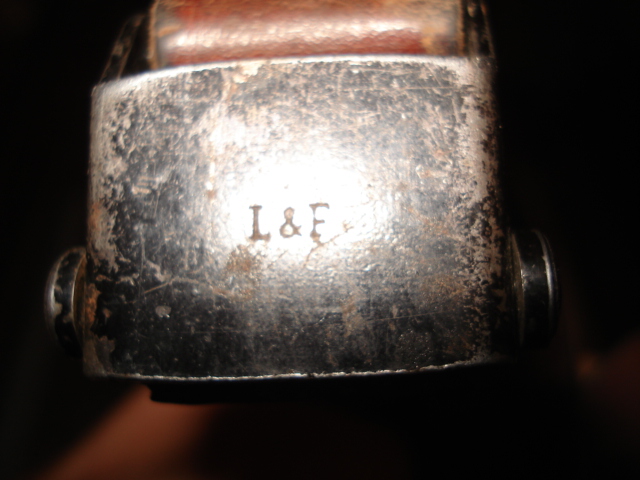 The finish of the metal includes blued as standard, no finish at all, phosphated and black burnt paint (not to be confused with black paint, which is normally postwar added for preservation.) 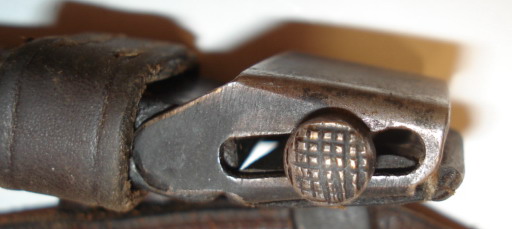 The sling was first issued with serrated locking pin heads on the roller buckle, to ease handling of the buckle. 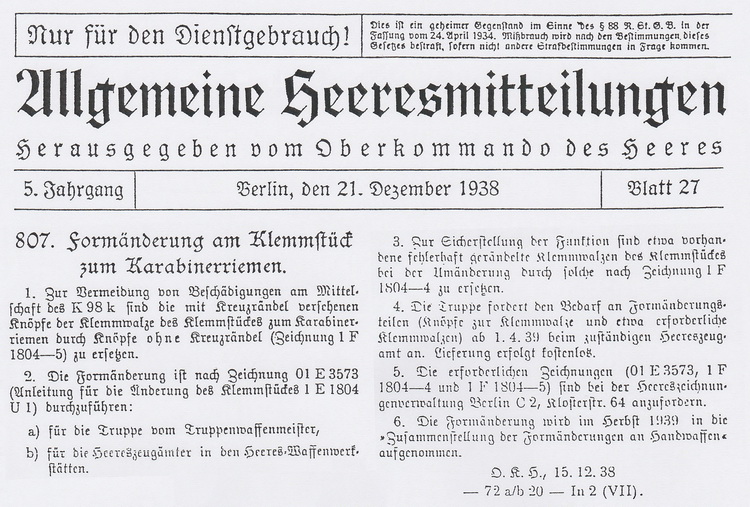 What seemed like a good idea in 1935 was totally reversed on 15 December 1938, when the OKH (Oberkommando des Heeres) ordered that all Karabinerriemen with serrated buckle pin heads should be rebuilt with flush ones (Knöpfe ohne Kreuzrändel). This was done to prevent the locking pin heads from damaging the wooden stock of the K98k. Note that this is an order to rebuild the inventory of Karabiner slings and Karabiner slings in use by the troops. It is still unknown when the manufacturers got the order to switch their production of J216 to non-serrated buckle pin heads, but I have found a specimen with serrated heads that was 1937 dated, so probably sometime during that year. Based on the orders reprinted above it is clear that all slings in use by autumn 1939 should have a non-serrated head. Slings surviving up until this day with serrated locking pin heads are specimens that "avoided" the rebuilding order above. The sling The leather sling had a ricasso pattern flanked by two lines impressed on the outside, while the inside was left in the "rough". The ricasso pattern was called "Fischhaut" ("fish skin"). Although sharp and clear on some slings, wear and tear will sometimes leave the ricasso pattern almost impossible to see on others. It was sewn to the buckle with two or three lines of stitches, depending on the manufacturer's choice. 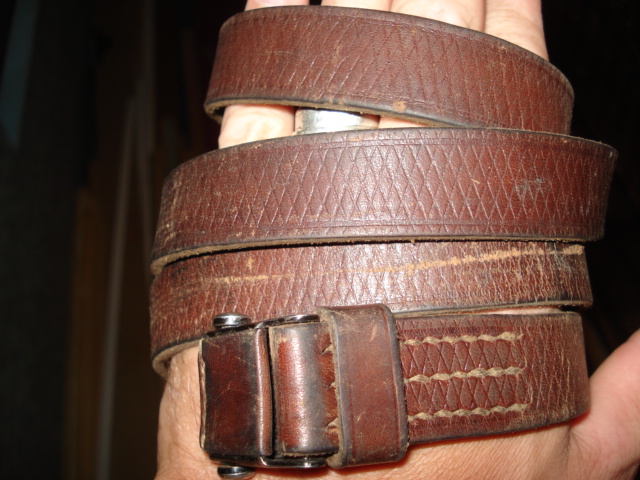 An extremely nice original sling, with a standard ricasso-pattern flanked by the two lines. 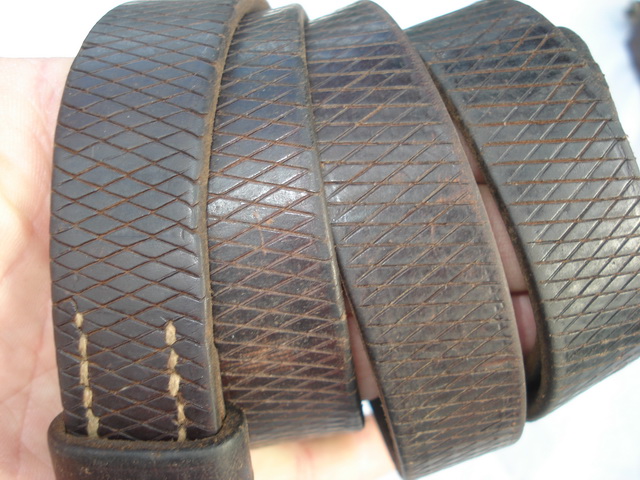 This sling has only got a very faint impression of the two lines left, while the ricasso pattern has been cut extremely deep into the leather. This sling was manufactured by "K Berger Prag X Königstr" in 1942. All slings from this maker that I have seen are dated 1942, which would suggest a single order. The marking is placed on the standard location, but crosswise. The "Berger" slings can be easily singled out by the deep ricasso pattern, never found on slings from other manufacturers. 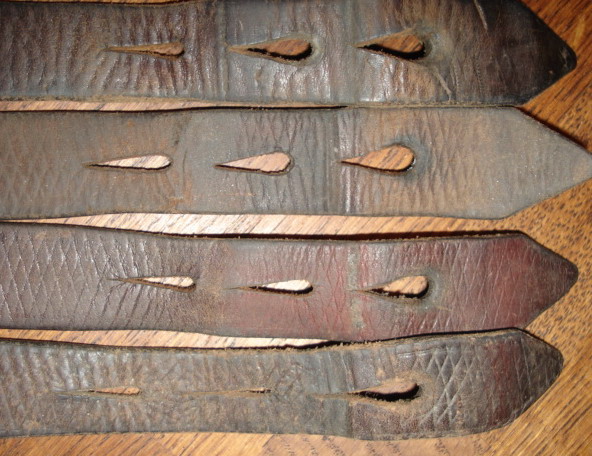 The end of the sling had three evenly spaced teardrop shaped holes. Leaving the factory, they would have been identical. But during use the leather will stretch, and the button would normally only be used at the end hole. Any signs of hand-cut holes indicate that the sling was tampered with. Some MP38 u. 40 slings have received a third hole to be used as a Karabinerriemen, but they are always easy to sort out. 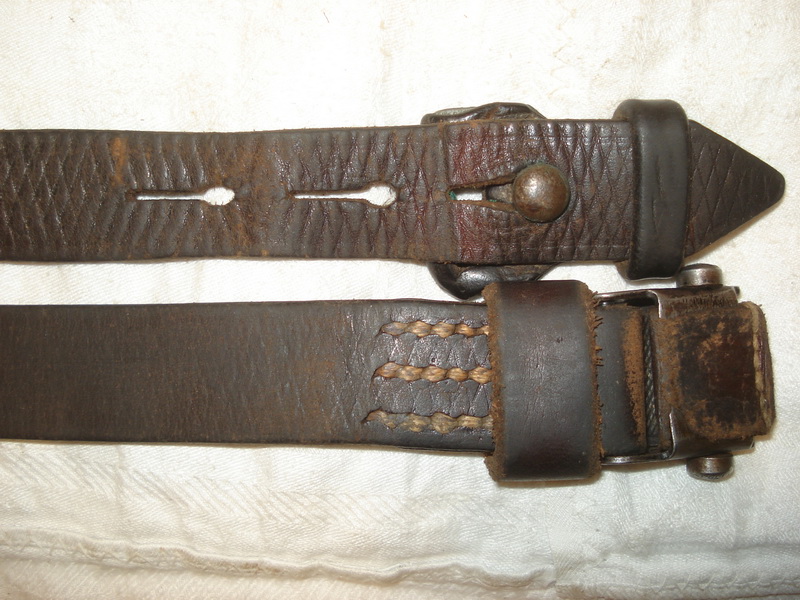 And again no rule without an exception. The slings marked "K&B Reichsheer" (assumed to be the maker Koch & Benning, Wuppertal) have holes stamped out with a different tool, consisting of a almost cylindrical hole with a square extension. 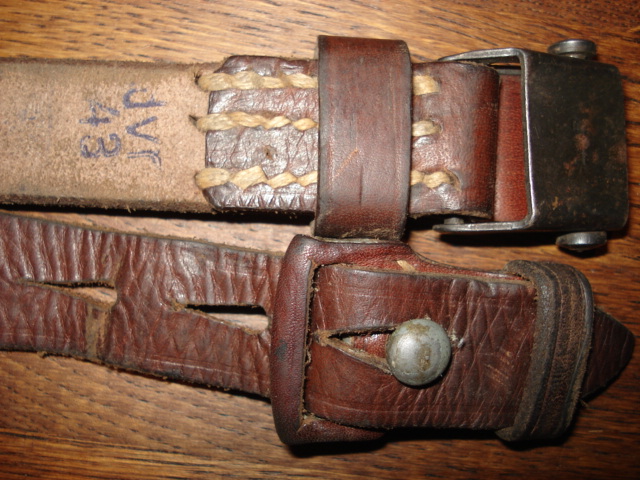 The outside was dyed brown, while the inside was left in the natural. Some specimens have been found without the ricasso pattern, but these are considered to be factory "misprints". 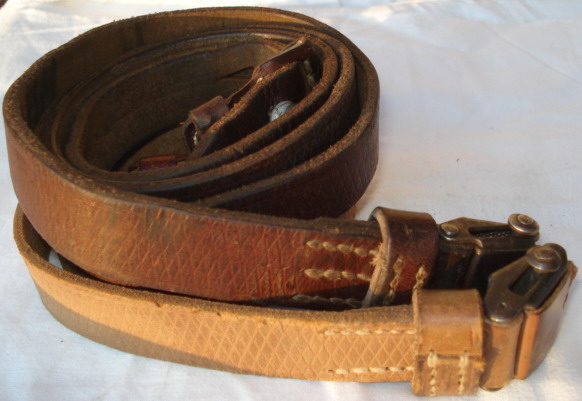 Here is an interesting sling that obviously left the factory in 1942 undyed compared with a normal sling (cgu 4). The undyed sling is also marked with a WaA, a inked "KAR" and a full maker/address, which is rather odd and contrary to regulations in 1942. Most slings that have seen any use will today appear dark-brown to black, as they of course constantly soak up residue oil from the gun, get handled while the gun owner cleans his gun with oily fingers etc. As a result of this the actual sling is often without markings. Slings dyed black does not exist. The K98k sling was marked in different ways, depending on the manufacturer. Most commonly the markings will be found on the inside, close to the top. The markings will consist of a maker, city and year on the early ones, while the mid-production ones have a WaA and three letter code and year. The late war ones omitted the WaA, and finally ended up with a RbNr. Some manufacturers only used their company logo.The markings consisted of either just an ink stamp, an ink stamp with light impressions or just impressions. 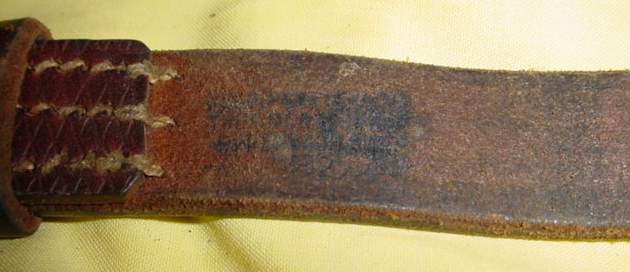 Needless to say, the ink stamps seldom survived field use, oil and dirt. 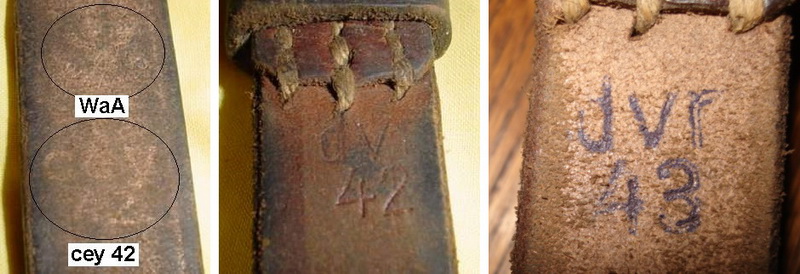 Markings done with metal stamps had a much better survival rate. But in the end it all depends on how much use the sling has seen.  In addition the wording "Kar." can also be found on some specimens, but only as an ink-stamp. This is short for "Karabinerriemen", and presumably put on to differentiate it from the "MP38 u. 40" sling which was slightly different. This marking was most of the time applied to the end of the sling, but can sometimes also be found at the start. A two digit number sometimes appear on the tip of the sling. This marking was probably connected with the production of the sling or cutting of the leather. 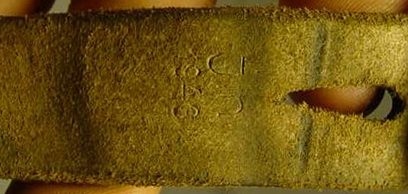 The maker marking or code and year have also been observed on the bottom part of the sling on the inside, but very seldom. 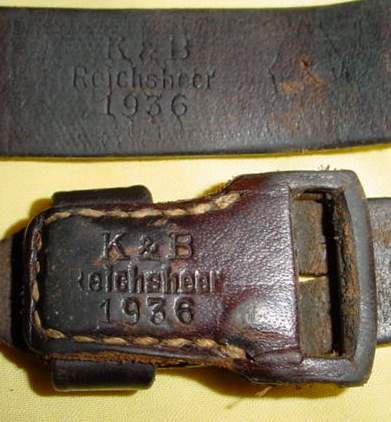 The rarest variant of the sling markings are the slings that have the stampings to the outside. I have only found a few specimens over the years. The ones marked "K&B Reichsheer 1936" is by far the easiest to find. Note the large Reichswehr /Weimar eagle to the right of the text on the sling. Note that "K&B Reichsheer" (assumed to be the maker Koch & Benning, Wuppertal) also manufactured slings marked on the inside. 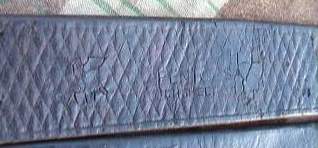 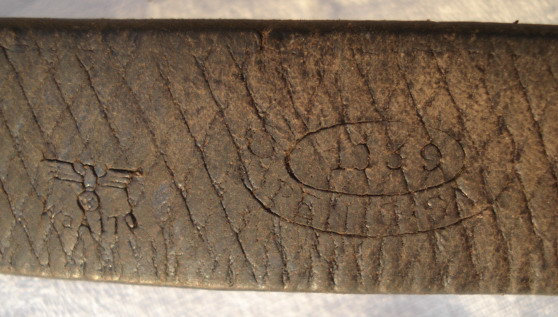 Two other examples of slings with the makers mark, date and WaA stamped to the outside of the sling. 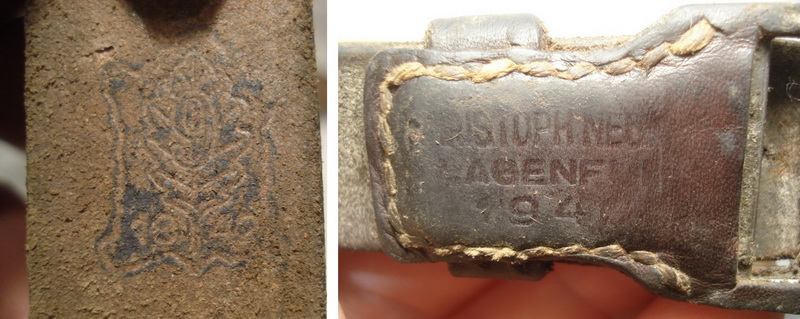 Christoph Neuner, Lederwarenfabrik, Klagenfurt marked his slings with the company logo only, which consisted of an outline of a boar skin, a leaf (as a symbol of the tanning industry) and the digit "9" for the family name "Neuner". The year of production is displayed beneath the leaf. The Haltestück above is marked with the full company name. The stopper (Haltestück) The rear sling stopper (or keeper) is more frequently found with markings. It's German name was "Haltestück" or "Riemenplatte mit Knopf". 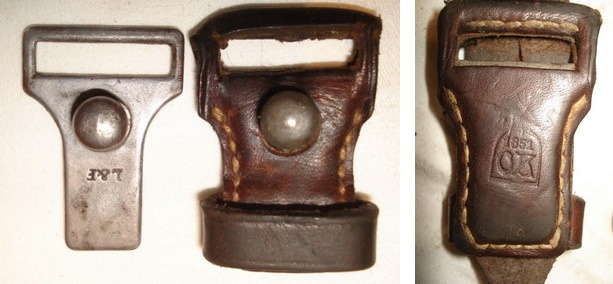 It has a metal centerpiece with a button, either made of brass or steel. The centerpiece was also made by subcontractors, as can be seen on this picture. A brass button appears on the early manufactured pieces, mostly pre-1937 made. As mentioned in the beginning of this article, the Haltestück was also used on the Einheitskarabinerriemen from WW1, so a lot of these would have been reused. The leather resembled that of the sling, but was a lot thinner. It was smooth most of the time, but some stoppers have a sharp and nice ricasso pattern embossed into the leather. The leather was hand stitched around the lower edge. Some specimens also have a second seam at the top to secure the thin strip, as can be seen in the picture above. 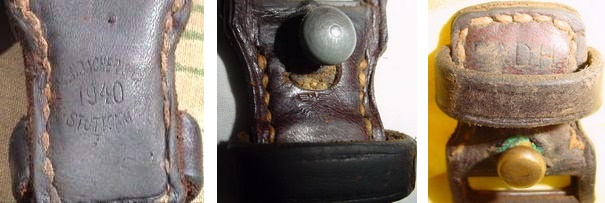 It can be marked in one of three places. To the rear, which is most common, between the button and the sling tab holder, or on the front tip. 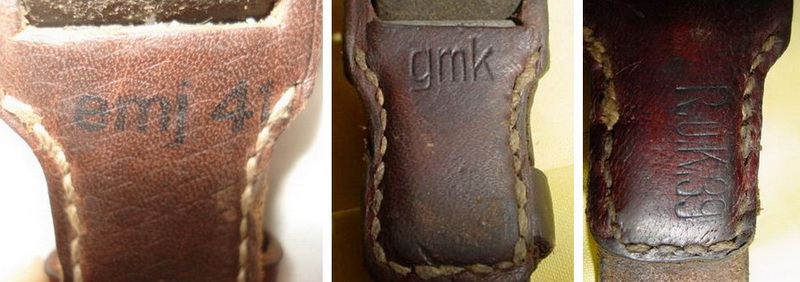 The markings will be in the same style as on the sling. Plain ink, stamped with a metal stamp or stamped with a metal stamp and ink. But again only the impressed markings have a good survival rate. 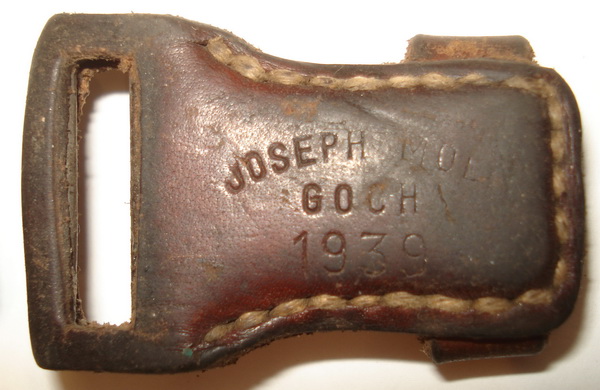 The most commonly found markings to the rear of the stopper are maker-city-year combinations (most often inside an oval circle) on the early ones, three letter code with or without year during 1941-1943 or just a single WaA. 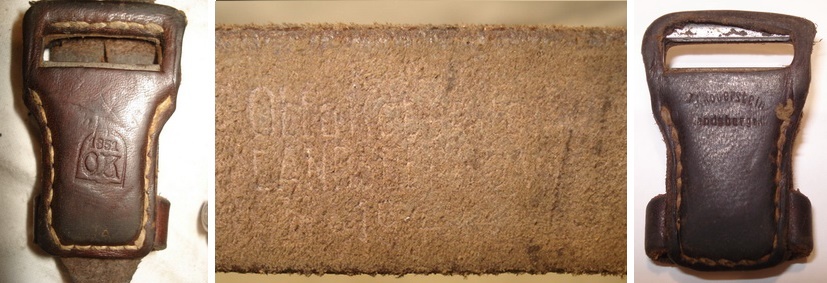 Otto Koberstein marked his slings to the inside with the full text "Otto Koberstein Landsberg a. W 194x", while he marked the stopper with a company logo comprised of the year of foundation, 1851, and his initials OK. He also manufactured some stoppers with his full name, although the "1851 OK" appears to have been the norm. 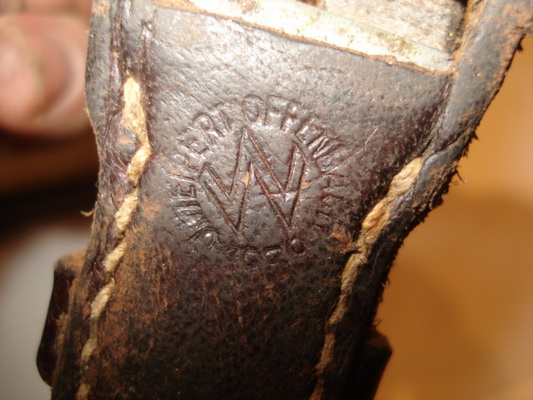 J. Weipert, Offenbach used this logo in 1939. A stylized "W" surrounded by the manufacturers name, city and 1939. 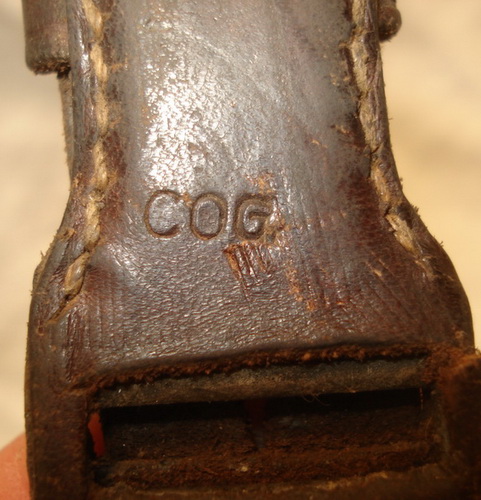 A stopper that is often encountered is marked "COG" in capital letters. This is not a code, but the maker's initials: C. Otto Gehrckens, Pinneberg. Never seen "COG" on a sling though, only the code issued for the same factory; "dtv". 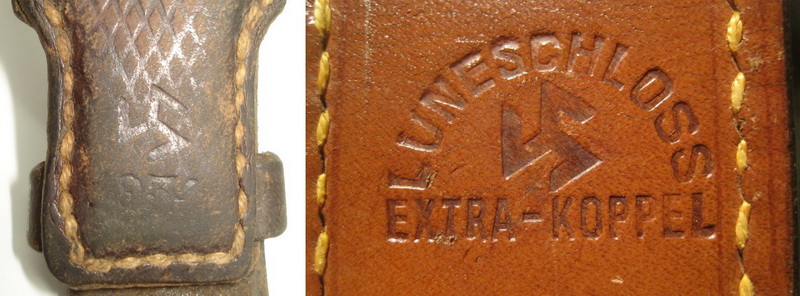 Ewald Lünescloss Militäreffekten-fabrik in Solingen marked their Haltestück with their three-armed Wolfsangel logo, and the year of manufacture 1934. The maker was identified by a stamp found on a leather belt. Their code was "dlu", but I have never seen the code on a sling. 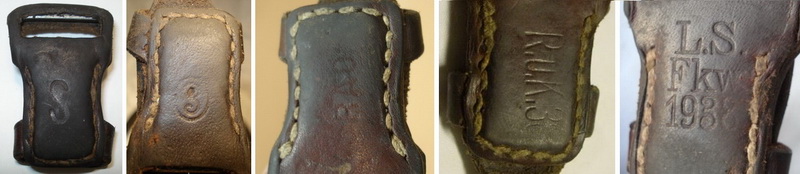 Some makers have so far eluded positive ID, as they marked their stoppers with their pre-code factory initials or logos, and can't be found among the makers that later marked their products with the standard codes. "S", "3", "RAO", "R.u.K." and "L.S. Fkw" are among these 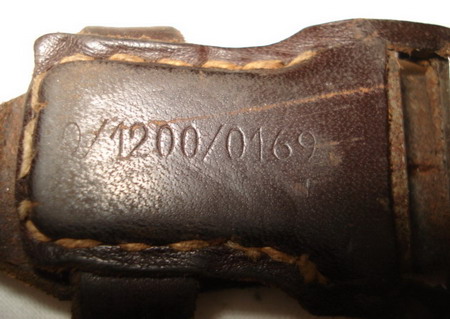 The last version, a stopper with a "Reichbetriebs Nummer" (RbNr). This coding system was introduced late in 1944 to replace the standard 3-letter code, but was never fully implemented. Added markings Special markings applied after the weapons and slings left the factory can also be found. 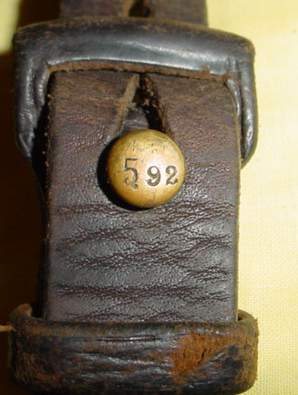 Some of the early brass button keepers has impressed what I believe is a unit number. 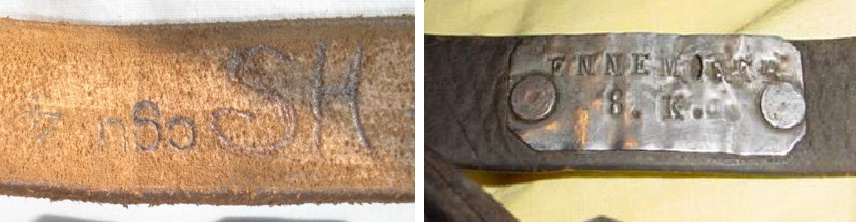 The soldier in the field has always liked to keep track of their equipment. A lot of methods have been used. In the first picture above a soldier has carved his initials "SH" directly into the leather. In the second example pictured here, he has added a small metal plate with his name and his unit's number, the eight company. ----------------------------------------------------------------------------------- It seems pretty clear that the stopper and sling was manufactured by the same maker and left the factory as a matching pair. Most slings today will not be matching though, first of all because the markings on the actual sling fades pretty quick during use, and secondly because of the usual mismatching conducted by soldiers in the field. 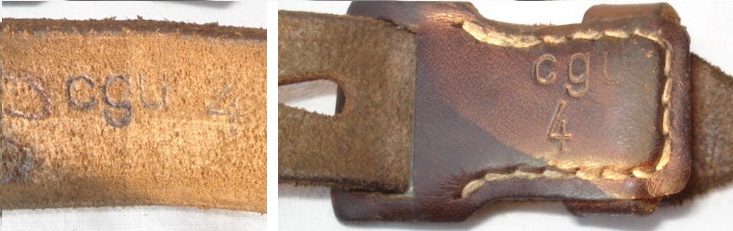 A late war matching sling marked cgu 4. In 1944 and 1945 the date was reduced to just one number. Of special interest is the fact that the code "cgu" was issued in WW2 to the maker "Stolla, Wien". This factory is very well known today for their postwar production of MP40 slings and magazine pouches. The slings are almost identical to the WW2 production slings, but was marked "Stolla Wien" inside an oval circle. I have no knowledge of surplus K98k slings marked this way, only slings for the MP38 u. 40. 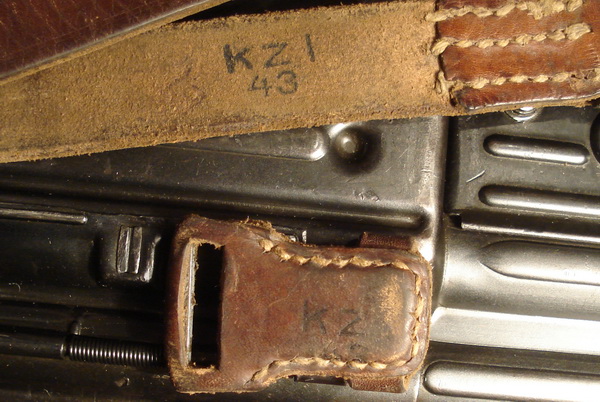 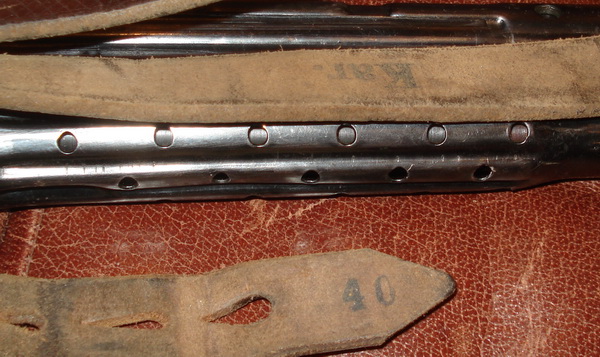 The ultimate sling has got it all. Nice, brown colored leather. The matching makers code with year on both sling and keeper, "Kar." in ink, and the number "40" from the production process. The article continues on the next page, just click here. |
| Home | For sale | Site map | Contact information | Guest book | Mauser slings page 1 | Mauser slings page 2 | Mounting instructions |